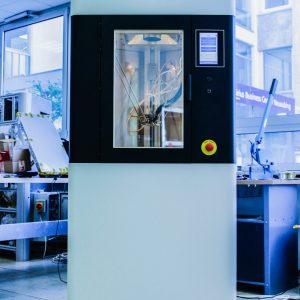
Last year, the Munich high-tech startup Kumovis not only the Baystartup wins Munich business plan competition, but also a Million-dollar investmentNow the company is launching the first 3D production printer with cleanroom integration. We spoke with the co-founder and managing director of Startups Kumovis, Stefan Leonhardt, spoken.
What are the possible applications of your new 3D printer?
In principle, our 3D printer can process a wide variety of plastics, which is why it can be used in a variety of industries.
However, our focus is clearly on medical technology, and our 3D printers are also specialized for this field. In the medical technology field, the printer can be used for a wide range of applications. This ranges from disposable surgical instruments to cutting templates for complex surgeries to customized implants.
However, it's very important to us that our printer can be used not only for research and development, but also for production. This fundamentally distinguishes us from other 3D printer providers, as a system suitable for production brings with it various requirements that often can't be met. These often include aspects such as the cleanability of the system or the materials used.
Additive manufacturing: material waste is minimized
What are the advantages of additive manufacturing in the medical field?
Basically, we see four major advantages:
First of all, additive manufacturing enables the decentralization of production and the manufacture of medical devices. A printing system like ours requires approximately one square meter of space, a high-voltage power supply, and compressed air. This means our system can be set up and used for production almost anywhere.
The next point is sustainability and cost-effective production. Implantable plastics are very expensive. We're sometimes talking about over 2,000 euros per kilogram. When customized implants are manufactured using milling machines, material waste of more than 80 percent is not uncommon. And that leads to enormous costs. With additive manufacturing, we can minimize this material waste and, with a little design skill, in some cases even eliminate it completely. This means we only need the amount of material that actually goes into the product.
The third point, and one of the most exciting in our view, is patient individuality. Additive manufacturing allows us enormous design freedom, which is why we can produce precisely fitting implants and create new structures, such as the finest lattice structures for improved bone ingrowth.
Finally, the implementation of digital workflows should be mentioned. Additive manufacturing can be seen as one of the physical arms of digitalization. Especially in medical technology, we can implement automated workflows starting with a patient data record and ending with the physical product.
Patented tempering system
What is special about your 3D printer?
We have developed the first 3D printer that is truly suitable for the series production of medical devices made of high-performance plastics.
The heart of our printer is our unique and patent-pending temperature control system. We have developed the first 3D printer that uses airflow to regulate the temperature of the build chamber. We can heat the build chamber to up to 250 degrees Celsius, thus achieving significantly higher mechanical properties than previously possible with FLM (Fused Layer Modeling) technology.
In addition, we can equip the air circuit with filter technology, creating a cleanroom environment inside the printer. This ensures that no foreign particles or abrasion particles are introduced into the printed parts, thus preventing defects or contamination.
Another unique selling point of our printers is their suitability for serial production in the medical environment, as already mentioned. There were some specific requirements here that we had to meet, and we also fulfill them with the Kumovis R1.
What materials do you use for production and why?
In principle, all thermoplastic (i.e., meltable) plastics can be processed on our 3D printer. However, we focus on materials that are also available in grades suitable for medical technology. We work closely with material manufacturers who are doing excellent work in this area and are bringing more and more materials to market.
For long-term implants, we focus on various high-performance plastics suitable for medical technology, such as PEEK and PEKK, which have been established as implant materials for years. Other exciting materials, especially in the CMF area (application area of the head: lower jaw, upper jaw, skull, etc.), are PPSU (a high-performance plastic suitable for medical technology) and Ultem. A new class of materials that is currently emerging are degradable materials, i.e., materials that degrade over time in the body. These will certainly play a role in the future, especially in the bridging of bone defects.
“Establishing a new technology in medical technology requires more than just a good idea.”
What are the biggest challenges in establishing a new product in the medical field?
Our goal from the outset was to develop a 3D printer suitable for the production of medical devices. And the keyword "production" is particularly important to us. One of the biggest challenges was therefore to develop our printer in such a way that even established medical device manufacturers would say: Yes, this is a system I can also use in production. From the very beginning, we also sought input on everything that needed to be taken into account. These are often requirements that might be dismissed as minor details, but are of great importance, especially in the medical field. This starts with the materials used for the machine and extends all the way to the surface finish.
A very Another major challenge is, of course, the issue of regulatory requirements. Machine qualification and process validation, in particular, are time-consuming and resource-intensive steps. However, our collaboration with large medical technology companies, which naturally already have extensive experience in this field, helps us here, too.
Another key issue is trust. Establishing a new technology in medical technology, in particular, requires more than just a good idea on paper. A general understanding of how medical technology works and the challenges associated with the approval process are of great value here.
Is your printer already in use?
Yes, our printers have been in operation for some time now. We've had several systems with pilot customers since the beginning of the year. Since August, we've been delivering the first printers to larger medical technology manufacturers, and we're naturally pleased that they're showing confidence in us and our technology. This means a lot to us and provides additional motivation to continue advancing 3D printing in medical technology.
In addition to our collaborations with industry, our printers are also already being used in various projects directly with hospitals. Hospitals in the Munich area are particularly strong partners for us in this regard. In collaboration with the Department of Dental Prosthetics at the Ludwig Maximilian University of Munich (LMU), we have already been able to use printed products in the dental field. An animal study with printed implants for mandibular reconstruction will begin in October with the Klinikum Rechts der Isar. These are always very exciting projects for us, where a lot of progress is being made and we are gaining a great deal of knowledge.
Kumovis: Vision of sustainable medical devices
What is your vision?
Our vision is to use our technology to sustainably change the way medical devices are manufactured, thus taking patient care to a new level. This includes, above all, the point-of-care application of the technology and the production of completely new medical devices that were previously unimaginable. This requires strong partners on all sides, as this can only be achieved through collaboration with hospitals, medical device manufacturers, material manufacturers, and technology manufacturers like us.