German households have unused items worth over one billion euros stored away—why not harness this potential and convert it into donations for social projects? A mammoth task that the creators of swop have taken on.
Who are you and what do you do? Please briefly introduce yourself and your services!
Swop We founded in 2014 as a team of five. Currently, there are two of us working full-time: Thomas Gärtner and Matthias Hoffmann. Tom and I met in 2001 in the German Armed Forces. We both served there for 12 years as officers in the Air Force, Tom in international project management and I as a technical officer for aircraft and helicopters. In 2012, we completed an MBA program together, which we completed in Abu Dhabi in 2013. After we returned to Germany, the plan was actually to immediately look for a job with an aviation company like Lufthansa or Airbus. But I decided not to do that for the time being and took a break. During that time, I came into contact with several founders, for whom I worked partly as a freelancer and partly in Istanbul. The desire to set up something of my own was there, but I wanted to create something in the social sector, to get more people involved in social engagement, digitally and without great effort.
At exactly the same time, I wanted to sell my IKEA TV bench on eBay classifieds, but at the time, I would have only gotten 20 euros for it. A year earlier, it had cost 140. I felt it would be better to donate the TV bench as a non-cash donation, so I went to a charity shop, but was sent away with the explanation that their warehouse was full. There wasn't another Variante to help a social project with, and I didn't want to drive all the way to Munich either. This experience led me to swop, which I was able to convince Tom to join.
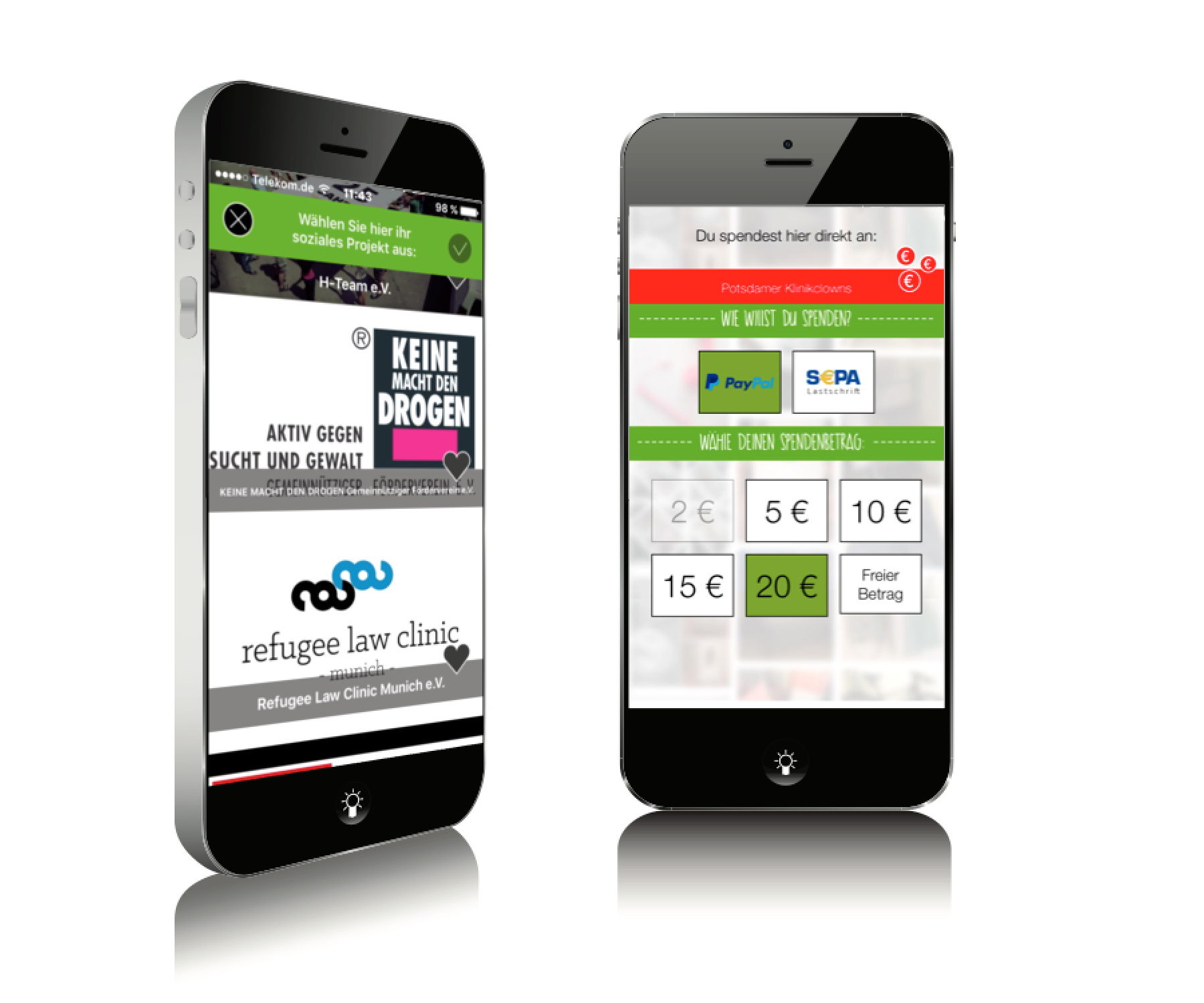
Swop is an online flea market, where monetary donations are collected for social projects. We differentiate ourselves from all existing online flea markets in two ways: Firstly, all proceeds—i.e., 100% of the monetary donations—are donated to social projects. Secondly, the new owner decides how much they want to donate for each item. Our target group isn't interested in the proceeds from the sale; they want to help with their used items. However, smaller social projects in particular can't do much with donations in kind unless they're specifically looking for certain items—but they can do well with monetary donations.
But that's been around for a long time!
Really? – well, yes and no. Of course, we are not the only digital flea market. From eBay classifieds to Spock and Stuffle, there are also sharing approaches or even the completely new possibility to sell via a chat bot, as with Selly.
Until now, you could keep your unused items, sell them, dispose of them, or donate them directly as a non-cash donation. Sharing, i.e. swapping or turning items into cash donations, is a completely different approach for me. I don't see swop as a solution that replaces existing ones, but rather as a useful addition. Some things are sold to buy something new with the money, but there are also items to which you don't want to attach any monetary value. In most cases, this is well below the purchase price, and you are sometimes genuinely dissatisfied, even if you still get the current value as proceeds. Swop is intended to leave people with a better feeling: that they have made someone happy and that they have supported a social project of their choice.
Which items are most frequently purchased through your app?
Good question – handbags, sofas and even DVDs often change hands.
What have been your biggest challenges so far?
Well, the swop concept was, is, and will likely remain a challenge. I don't think we've yet found the key to ensuring regular use of swop. Specifically, it means that the effort required to list individual items is probably too high for users. We need to overcome this hurdle differently. We have a few ideas in the pipeline. We've been developing the concept in leaps and bounds since 2014, discarding unnecessary elements and incorporating new aspects at each step. But something is still missing for swop to truly complement the donation market with a good and meaningful alternative and help social projects generate more donations. But we won't give up—after all, German households are storing unused items worth over a billion euros. We'll turn a small portion of this into monetary donations.
How and what do you earn?
The business model behind swop is based on providing fundraising services to social projects that receive monetary donations through swop. We receive 15% of this, which is conditional on success. Currently, we neither cover costs nor pay ourselves salaries with this. A few months ago, we began offering a B2B model for large companies alongside swop, based on the principle of a social flea market. It's called Pinboards and focuses on employee social engagement. Companies receive software, both available as mobile and web versions, and pay an annual software license. Employees can, among other things, advertise their items and donate in a swop-like format. We already have customers and many inquiries from large corporations. Apparently, we've struck a chord here.
What criteria do you use to select the social projects that can be supported through swop?
The main criterion is a non-profit certificate issued and confirmed by the tax office. When a social project registers through our website, we verify the purpose of the association, foundation, or limited liability company (GGmbH). Here, we focus on how the donations will be used within the organization. If all of this is in order, the projects create their own profile in just a few minutes, are immediately online, and can be selected as a beneficiary organization by swop users.
What does Munich mean to you?
Munich is a great place to start a startup. If you know where the hotspots are, you'll meet the right people. Our first stop was the Social Impact Hub, Plant1 and the Social Entrepreneuship Academy. The start-up funding advice from the Chamber of Commerce and Industry Upper Bavaria, then owned and represented by Markus Sauerhammer. Here, we received free, personalized advice on trademark protection, corporate law, and other topics. There's definitely still room to improve in some areas where the city could support startups – office rent is, of course, an issue for startups. Creating more affordable co-working spaces would be a good idea. While there are co-working formats, they're very chic, but also very expensive.