Munich Startup: What does AwesomeQA do? What problem do you solve?
Alexander Abstreiter, co-founder and CEO of AwesomeQA: Our startup is developing a AI-powered community management solutionWe enable software startups to gather and interact with their users in community channels like Discord. We've noticed that many community managers are overwhelmed by the volume of customer service requests, leading to high user churn. With AwesomeQA, we can address this challenge by automatically answering frequently asked questions in seconds using AI. We also prepare the collected data for our customers, giving them insights into the biggest pain points of the current user experience and the most requested new features.
Improved knowledge management flow
Munich Startup: But that's been around for a long time!
Alex Abstreiter: That's right, other customer support solutions also offer automated customer service. However, AwesomeQA differs in several aspects. We built our product with AI from the ground up and directly integrate community channels like Discord and Telegram. Unlike many competitors who rely solely on ChatGPT, our AI has a much better knowledge management flow. It automatically learns from each community manager's answers and additionally leverages knowledge from websites, documentation, and forums. This avoids the problem of hallucination, meaning we significantly reduce self-conscious incorrect answers.
Munich Startup: What is your founding story?
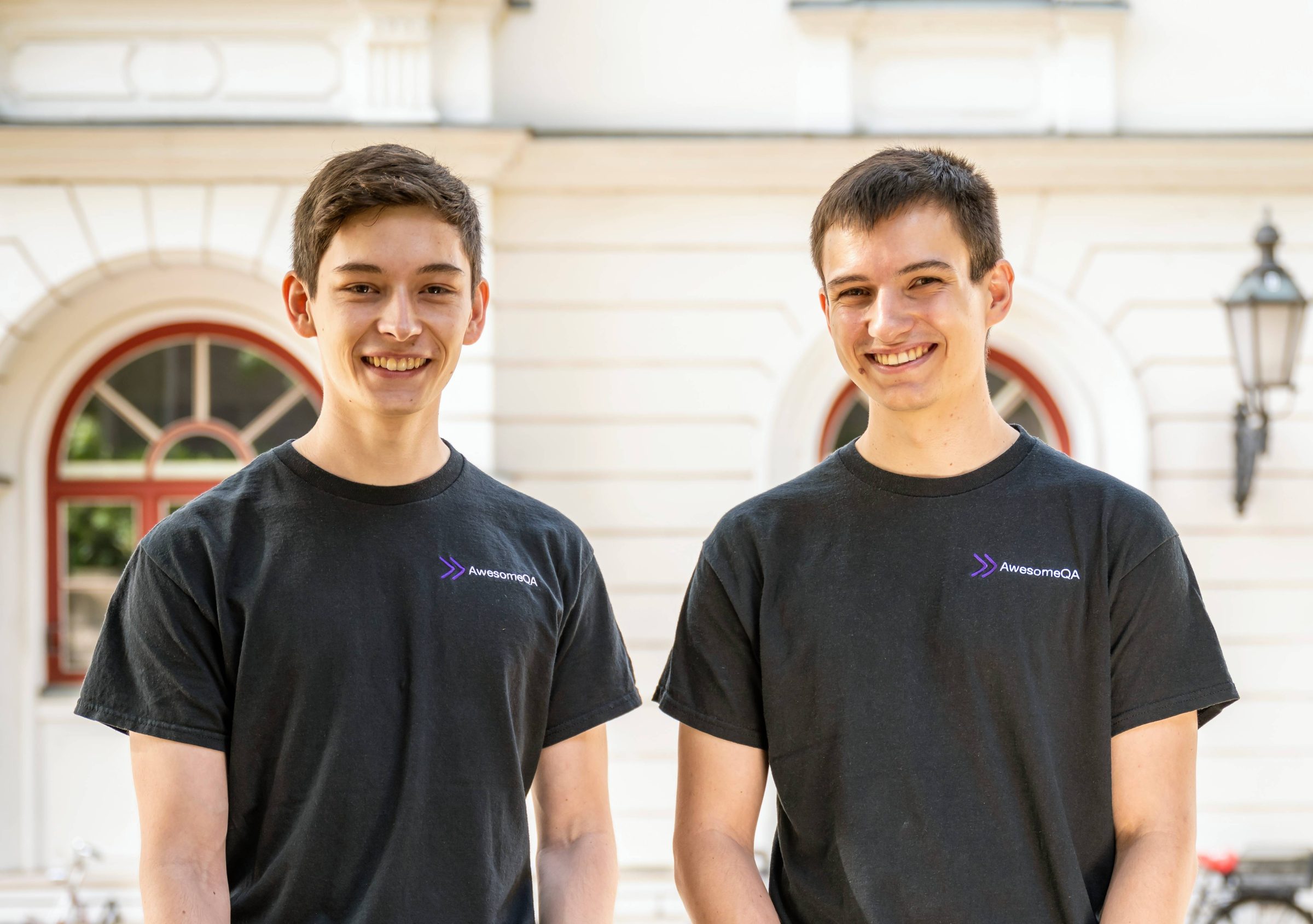
Alex Abstreiter: My brother and I had already shared the desire to found a startup together during our studies. When my brother completed his master's degree in data science, I quit my job to work together to find solutions. At hackathons, we encountered the problem of poor user experience in communities because we couldn't find relevant information. We then developed an initial prototype, which received extremely positive feedback. Using this feedback, we iteratively improved and expanded our product.
AwesomeQA: Already over 60 customers
Munich Startup: What have been your biggest challenges so far?
Alex Abstreiter: One of the biggest challenges was acquiring the first customers. Integrating a tool into a Discord community can also pose security risks. Since we had no references at the beginning, potential customers were initially cautious. We had to adapt our messaging several times to ultimately convince them of our product. However, once we acquired the first customers, this issue was no longer a major obstacle.
Munich Startup: How are things going?
Alex Abstreiter: We're thrilled that AwesomeQA is already successfully deployed by over 60 customers. Our AI answers thousands of user questions every month, reaching millions of end users across communities. We're continuously working on integrating more platforms and expanding our functionality to become the leading operating system for communities.
Munich Startup: How have you experienced Munich as a startup location so far?
Alex Abstreiter: Munich has continued to develop as a startup hub year after year, and the network of founders here is truly first-class. Thanks to renowned universities such as TUM, LMU, and CDTM, there is a wealth of talented individuals who are particularly valuable for startups in their early stages.
Munich Startup: Hidden champion or shooting star?
Alex Abstreiter: As a B2B SaaS company, we're currently something of a hidden champion, as the impact of our product isn't immediately apparent to many users. Although millions of users see our name when we answer their questions, they often don't realize that companies are using our analytics to close the community-product feedback loop and improve their products.