Munich Startup: What does Leverage Robotics do? What problem does it solve?
Roman Weitschat, Leverage Robotics: We at Leverage Robotics are a spin-off of the German Aerospace Center (DLR) and aim to make the production of the future more flexible and efficient with the help of lightweight robots. To this end, we are developing highly flexible and intelligent plug-and-produce robot cells for fast setup times in multitasking applications.
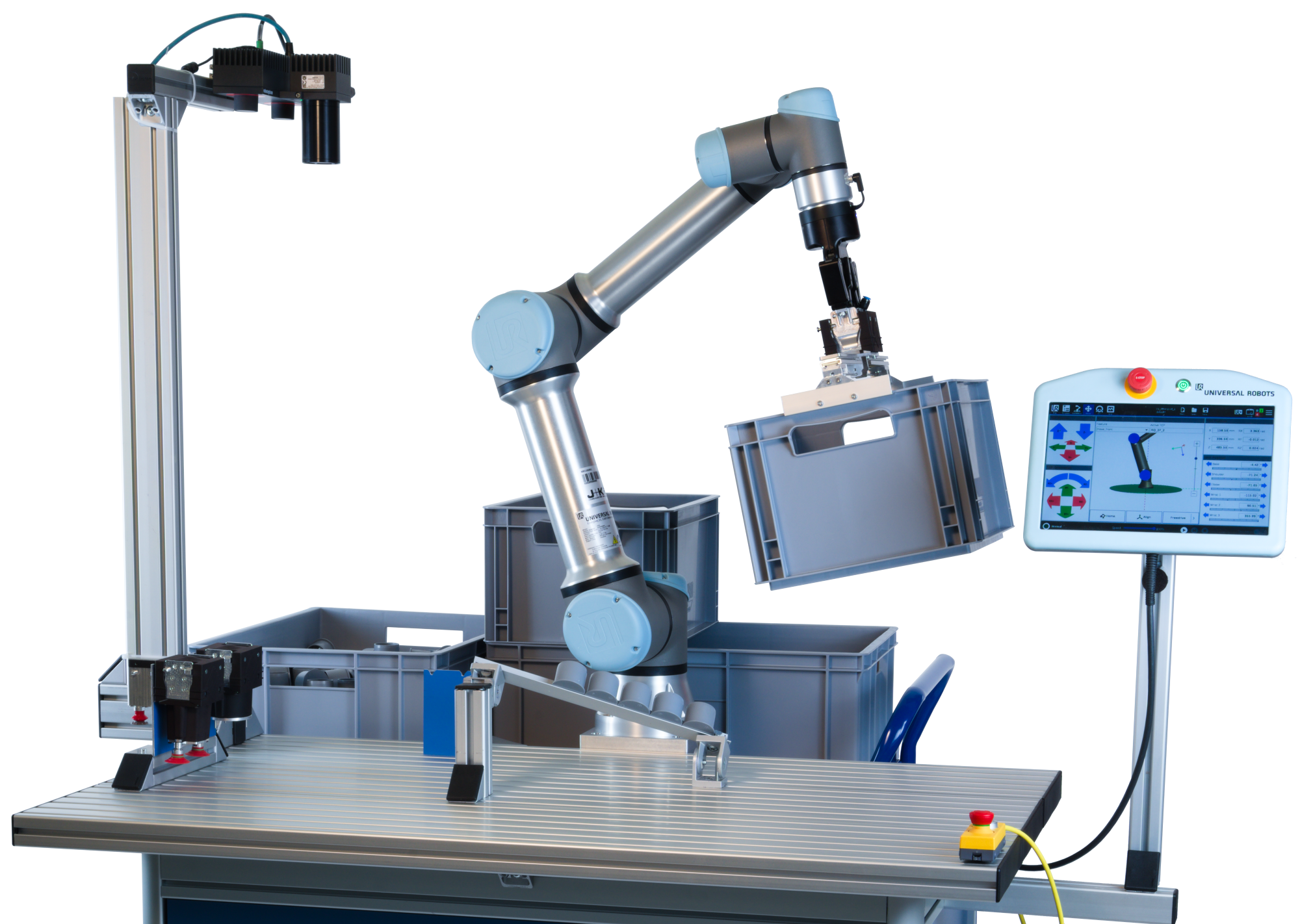
With our innovative robot tool technology, complex and diverse tasks in the areas of logistics, assembly, quality, and especially machine loading and start-of-line applications can be efficiently implemented. Each of these tools features software modules, known as robot capabilities, that enable intuitive robot programming even for non-experts. This enables regional production and avoids outsourcing with long delivery routes.
Munich Startup: But that's been around for a long time!
Roman Weitschat: Yes. Conventional robot systems lack flexibility and often have long setup times to process different products or automate smaller series. Newer robot stations rely on tool-changing systems that are exclusively active. This means that a gripper must be completely replaced with another gripper, and thus power or pneumatics must always be passed through. Furthermore, additional connections to the control box and the overall system are required. This means setup times are significantly longer than with our tooling system. Our tools are passive. This means they are purely mechanical and are operated by a conventional two-finger robot gripper.
What robots can do thanks to Leverage Robotics is unique
Similar to how a craftsman squeezes his pliers, we transform this movement in our "ToolCubes," thereby inducing magnetism or generating negative pressure. This allows us to perform magnetic or suction-gripping tasks purely mechanically. This is unique on the market. With this technology, we can convert robot stations in a snap and implement complex robot applications much more easily and intuitively.
Munich Startup: What is your founding story?
Roman Weitschat: As a research team in the "Factory of the Future" area at the German Aerospace Center, we have spent many years researching flexible, self-converting, and intelligent robot stations and have also collaborated with industrial partners in this regard. We noticed the need for high flexibility, which was primarily limited by robot tooling. To address this, we invented passive tooling, wrote an EXIST research transfer proposal, and developed the technology. EXIST then initiated the founding of a company, and now we are operating independently with a seed investment.
Munich Startup: What have been your biggest challenges so far?
Roman Weitschat: The biggest challenge so far has, of course, been a solid technical implementation, which I think we've solved very well. And the ability to operate as a company. The main focus here was finding investors. They're essential to further developing such cost-intensive (robotic) technologies and adding new ones.
Goal: More competitive with automated production
Munich Startup: Where would you like to be in one year, where in five years?
Roman Weitschat: So in the short term, our goal is to expand our distribution network and get many of our products into industrial production.
In the long term, we are working to make product manufacturing competitive in Europe through automation, avoid long delivery routes, and enable regional, economical production.
Munich Startup: How have you experienced Munich as a startup location so far?
Roman Weitschat: Munich is a very good environment for startups. There are many events, coaching sessions, and other startups with whom we can exchange ideas. However, finding staff is very difficult. Many large corporations like Google, Apple, and others are located here, offering very attractive positions. This makes it very difficult for startups to attract good people.
Munich Startup: Quick exit or long breath?
Roman Weitschat: It depends on the offer. Joking aside, we're fundamentally working on building a solid company and ensuring healthy growth. That's always been our goal. However, integrating it into a strategic partner company is also conceivable.