According to a recent study, Munich is Germany's most important tech hub—and also has the greatest potential for the future. Berlin follows in second place, ahead of a surprising hidden champion.
Munich is shining brightly—at least as a location for tech companies, the Bavarian capital is leading in Germany, according to a recent study by the consulting firm Deloitte. Munich leads the nationwide rankings both in terms of tech status, i.e., its current status, and in terms of future tech potential. In other words, Munich ranks best among German ICT locations, and the study expects the greatest growth for Munich. Munich ranks first or second in 11 of the 15 individual indicators.
“What is remarkable about Munich’s current position in the area of digital talent is that the city has a very high level of specialization in the ICT industry and, at the same time, has by far the most STEM professions in the entire urban economy,”
says Alexander Börsch, Chief Economist at Deloitte.
“This makes Munich a leader not only in the original digital sector, but also in the digitalization of traditional sectors.”
Status as a tech hub determines economic success
Berlin follows Munich in second place, ranking second in current status and third in potential. Although the German capital has more than twice the population of Munich, in absolute terms, more people are employed in the ICT sector and STEM professions in Munich than in Berlin. Third place in the ranking is somewhat surprisingly taken by the university city of Darmstadt. Although this hidden champion currently only ranks ninth, it has the second-highest potential of all German tech hubs.
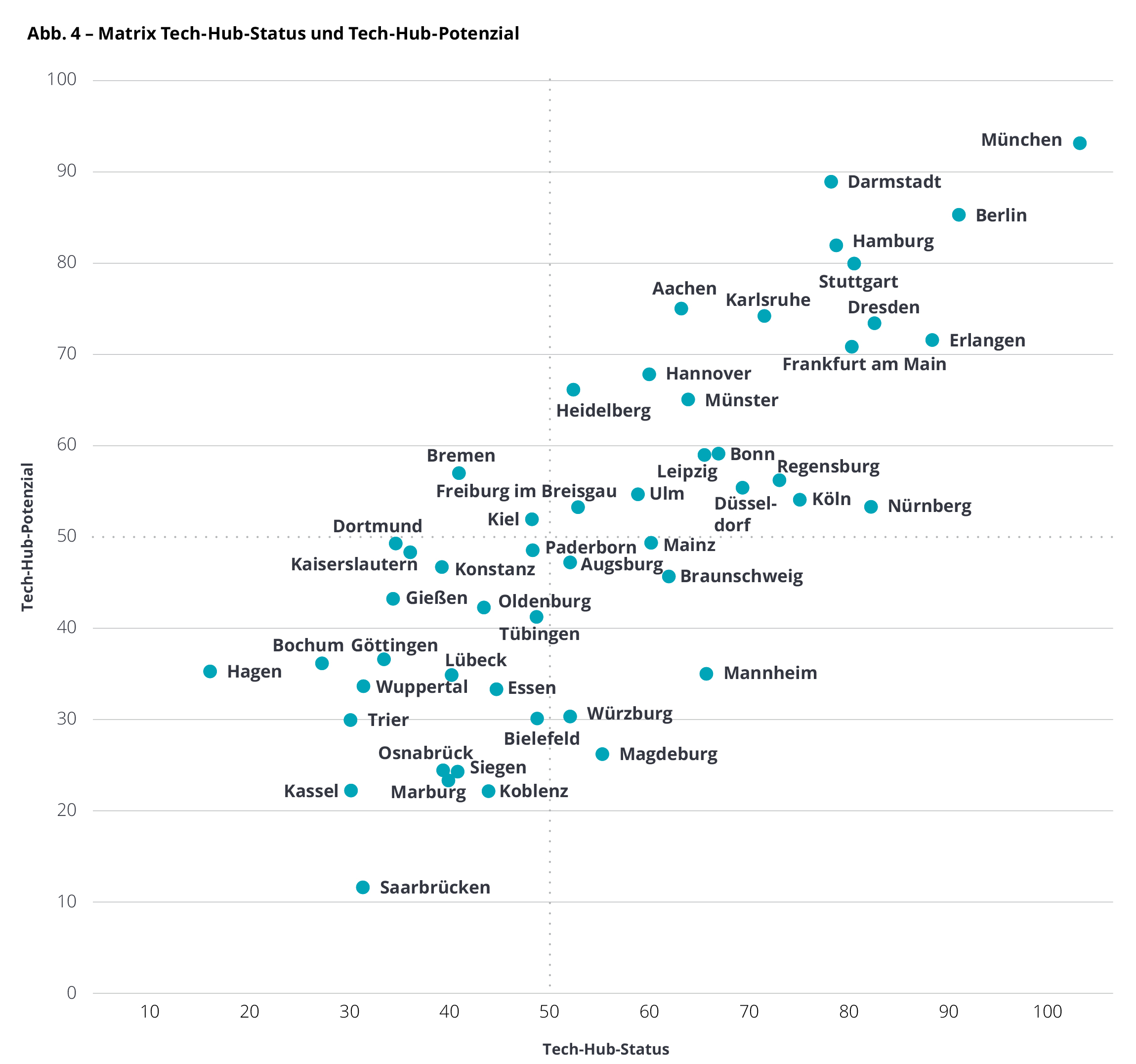
According to the study authors, success as a tech hub is crucial for the success of the entire business location. There is a close correlation between the proportion of highly skilled technology jobs in a city and per capita income. A city's status as a tech hub therefore also holds great potential for prosperity.
“Digital transformation puts technology at the heart of the economy and companies,”
says Nicolai Andersen, Head of Innovation at Deloitte.
People at the center of the digital economy
The most important competitive factor for tech hubs, according to Andersen, is skilled workers:
“If you want to be successful in this industry, you need innovative minds.”
It can be clearly stated that companies and capital follow talent in the digital economy. This places people at the center of the digital economy, according to the study. Knowledge is increasingly becoming a decisive factor for production and location. A successful tech hub must therefore offer a high quality of life to attract skilled workers and thus also companies. However, the national benchmark is losing its validity. In the future, Munich will primarily compete with regions such as Silicon Valley, Tel Aviv, and Stockholm.