Munich Startup: Who are you and what do you do? Please introduce yourselves briefly!
Sum: We simplify every type of text so that everyone can understand it and no one is excluded from important information. Specifically, we have “Google Translate” for easy language Built on the left side, insert the complex text, click "Translate," and then the simple text automatically generated with the help of AI appears on the right. It's a tool for translations within a language, but into a simpler language style, so-called "Easy Language."
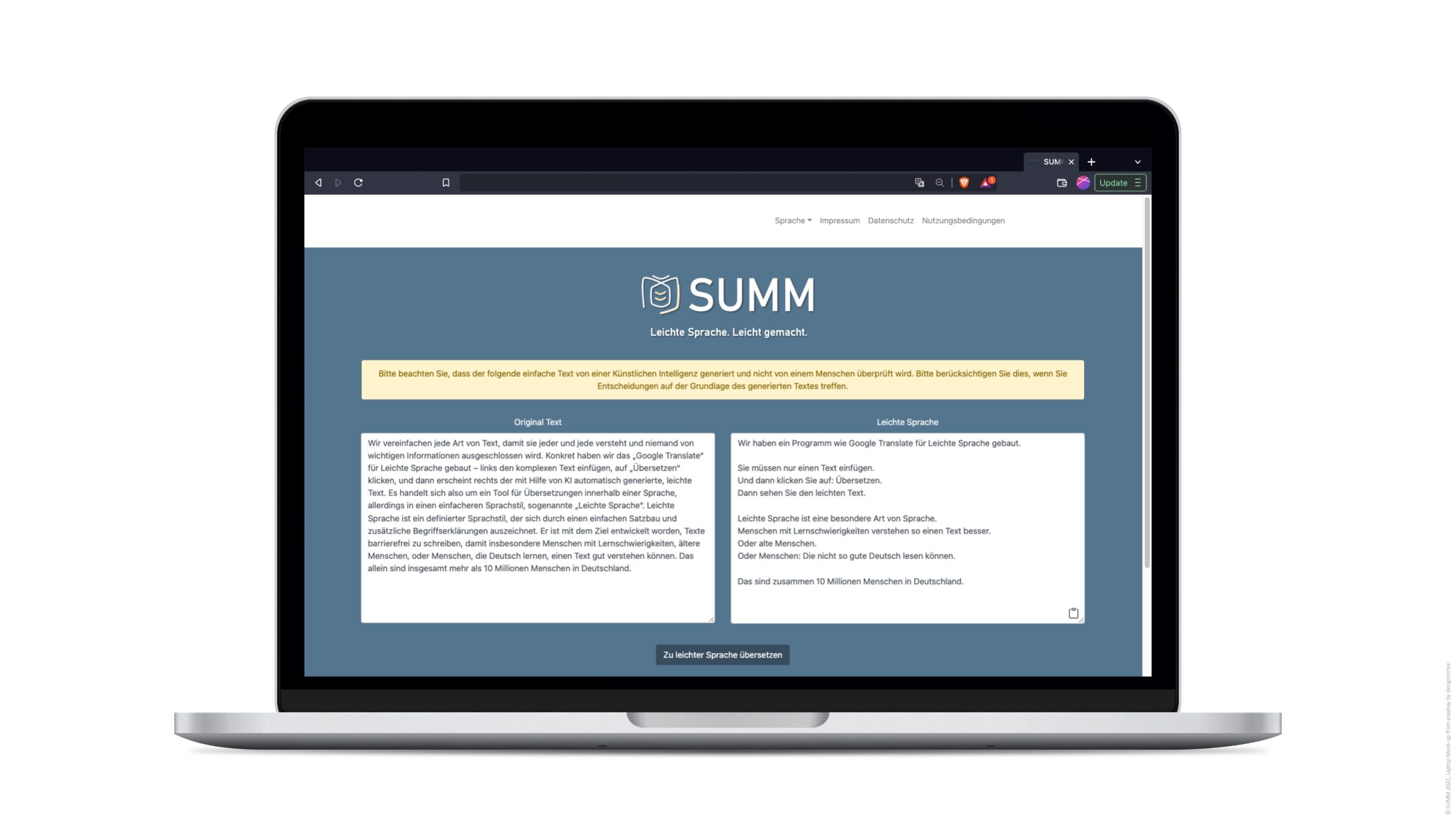
Easy Language is a defined language style characterized by simple sentence structure and additional definitions of terms. It was developed with the goal of making texts accessible, so that people with learning difficulties, older people, or people learning German can easily understand a text.
That's a total of more than 10 million people in Germany alone. Why does it "have" to be done with AI now? Currently, texts are manually translated into plain language. This is quite expensive and takes a long time – according to our market research, we're talking about around 100 euros per page and at least an hour for translators to translate each page of text. There are also long waiting times as the increasing number of texts is being translated. This is partly due to the fact that public institutions in Germany are legally required to publish information in plain language.
Understandable language also in the legal and medical fields
Furthermore, more and more companies are recognizing how important it is to communicate with customers and employees in a truly understandable and inclusive way. This topic is also much more widespread in general, as everyone is familiar with difficult-to-understand texts. In the future, we also want to make texts in particularly complex areas, such as legal texts or medical information, accessible to everyone by automatically simplifying these texts.
Munich Startup: But that's been around for a long time!
Sum: You'd think so, because quite a bit has already been achieved in the field of foreign language translations with technical support. However, this is definitely not the case with plain language. This is due, among other things, to the fact that one cannot translate "one-to-one" here; rather, an abstraction of the text must also be implemented technically. This means that the content of the text must be transferred to a different level of abstraction. In the next step, the content is then rendered in a different language style and enriched with additional explanations. Not only does this sound complicated, it's also technically not trivial. We're the first to have achieved this!
Munich Startup: What is your founding story?
Sum: We, the three founders Vanessa, Nicholas and Flora, know each other from our studies at the Technical University of Munich. We met in an interdisciplinary Master's program in Finance & Information Management – “FIM” for short – and realized pretty quickly that we in our team were practically born with the tools to start a company, as we cover the fields of mathematics, computer science and economics.
Passion for Natural Language Processing
Furthermore, we share a passion for natural language processing. After our initial projects in this area, both in research and practical applications, we were looking for a use case that also had a strong social component.
Commercial applications in the field of AI are currently on everyone's lips, but we were confident that an attractive business case could be combined with a meaningful application of the technology for our society. We became aware of the field of easy-to-read language, partly through a family member on our founding team who benefits from easy-to-read offerings, and we are overwhelmed by the response the topic has generated—both within the domain and beyond when we report on Summ.
Munich Startup: What have been your biggest challenges so far?
Sum: As so-called “first-time founders,” everything we are currently experiencing is new and challenging: making strategic decisions at the right time, organizing ourselves as a team, building structures and processes because new test customers are joining us every day.
Last year, we completely refocused and pivoted our use case. Making this decision after working on two topics in parallel for a while was difficult, but at the same time, it was very liberating when the time came. After making the decision, we quickly realized that we were on a really good and socially highly relevant path with the topic of Easy Language.
Established in the DACH region
Munich Startup: Where would you like to be in one year, where in five years?
Sum: In one year, we want to have massively expanded our customer base and established our tool as the Easy Language tool in the DACH region. In five years, we want to have expanded our offering in various dimensions: Easy Language in additional foreign languages, various levels of text simplification, and the targeted simplification of specialist texts in highly complex areas, such as legal or medical contexts.
Munich Startup: How have you experienced Munich as a startup location so far?
Sum: We can hardly imagine a better location than Munich! This is especially due to the excellent support we receive as a startup within the TU Munich ecosystem. We are currently part of the Xpreneurs Incubator of the UnternehmerTUM and have already benefited from various coaching sessions, workshops and valuable contacts, including through the TUM Venture Lab Software/AI We can benefit from this. In the large network we've been able to build, we now have a direct contact person for many questions and challenges, as well as quick, uncomplicated support, and we feel very well positioned for the future.
Munich Startup: Quick exit or long breath?
Sum: One thing is clear: staying power! We dedicate ourselves every day to ensuring that we realize our vision of universally understandable information for everyone and can unleash our positive impact on our society. Change usually doesn't happen overnight, so we're prepared to give our all for our vision, even in the long term!
Version of the interview in “German easy”
Disclaimer: The following text was generated by artificial intelligence. It is used for demonstration purposes of the Summ Easy Language tool. It was not created by an easy language expert or reviewed by a review group.
Munich Startup: Who are you and what do you do? Please introduce yourselves briefly!
Sum: We built a program like Google Translate for easy language.
You just need to insert some text.
And then click on: Translate.
Then you will see the easy text.
Easy language is a special kind of language.
People with learning difficulties understand such a text better.
Or old people.
Or people: Who can't read German very well.
That’s a total of 10 million people in Germany.
The texts in easy language are currently created manually.
This means that the texts are translated by people.
That's very expensive.
It costs about 100 euros per page.
And it takes a long time:
A translator works for approximately one hour per page.
The translators also have little time.
Because there are more and more texts in easy language.
This is because:
Public institutions in Germany must use easy language.
These are for example:
- City administrations
- Insurance
In addition, more and more companies are producing texts in easy language.
In the future, we want to automatically make even very difficult texts easier.
For example:
- Legal texts,
- Information from the doctor.
Munich Startup: But that has been around for a long time!
Sum: You might be thinking: That already exists!
We say: This is the case with foreign language translations.
But this is not the case with Easy Language.
This is because:
That it is not so easy to translate in easy language.
You have to explain the content of the text differently.
This means you have to rewrite the content.
And you have to write more explanations about it.
It's not that easy.
We'll be the first to do it!
Munich Startup: What is the history of your company?
Sum: We are three founders.
Our names are Vanessa, Nicholas and Flora.
We know each other from university.
This was an interdisciplinary master's program.
This means that we studied different subjects before.
We noticed:
We are good at different things.
We are very interested in artificial intelligence.
We have done many projects on the topic of artificial intelligence.
Artificial intelligence is also spelled: AI.
We noticed:
There are many things you can do with AI.
But we thought:
We want to do something good for people with AI.
We know from our families:
People with disabilities need help reading.
And we thought:
Providing support for this is a great idea!
Munich Startup: What has been difficult so far?
Sum: We have never founded a company before.
We have to learn a lot of things first.
For example: How we organize the company properly.
That's difficult.
But also very exciting.
Last year we reoriented ourselves.
Because we had two ideas.
We have decided on an idea.
That was difficult.
But also good.
Because we realized: The Easy Language program is a good idea.
Munich Startup: Where would you like to be in one year? And where in five years?
Sum: This is what we should be like in a year:
We want to have many new customers.
And our tool should then be known throughout the DACH region.
DA-CH is a short word for these 3 countries:
- Germany
- Austria
- Switzerland.
In 5 years we want to do even more things.
For example:
- Easy language in other languages.
- Easy language with various difficulties.
- Easy language for various topics.
Munich Startup: Munich is a location for new companies. What's it like for you here?
Sum: We really like Munich!
The university here helps us a lot.
The university is called TUM.
TUM stands for Technische Universität München.
There is a special position here for new companies.
It’s called Entrepreneur-TUM.
We received a lot of information from the Entrepreneur-TUM.
So that we can get better.
Entrepreneur-TUM helps us with many things.
For example:
- The Entrepreneur-TUM helps us with advice.
- Entrepreneur-TUM helps us with workshops.
We have many contacts through the Entrepreneur-TUM.
We can call someone: If we have a question.
And when we need help.
We also run a program at the Entrepreneurship University of Munich (TUM): It’s called XPRENEURS.
The program helps us a lot.
Munich Startup: Do you want to sell your company quickly? Or do you want to work for the company for a long time?
Sum: We want a better world.
That's what we work for every day.
It often takes a long time for something to change.
We want to do this until it works.