The startup Nebumind from Taufkirchen near Munich has developed software that ensures the quality of components, primarily in the aerospace industry. However, production in the aviation, automotive, and medical technology sectors can also benefit from the solution. Co-CEO and co-founder Caroline Legler answers our 7 questions.
Munich Startup: Who are you and what do you do? Please introduce yourselves briefly!
Caroline Legler: We are Nebumind, founded by Franz (38) and Caroline (32). Franz and I met in our previous jobs at Airbus, where Franz worked in central research and I in innovation. For over two years, we successfully built a spin-off for Airbus specializing in sensor technology before we left corporate life and went into business for ourselves. Our knowledge of manufacturing, component quality, and data processing is now of course beneficial to us.
Munich Startup: What problem does your startup solve?
Caroline Legler: Sensors are increasingly being used today to monitor the quality of components such as aircraft doors during production. However, these sensors only help monitor known weak points. Often, components still exhibit unexplained defects at the end of production. With current methods, it is usually too expensive and time-consuming to trace such defects back to their source. Instead, the defective product is discarded or repaired.
But even if the exact source of a defect is known, manufacturing facilities don't immediately adjust their machines because it's unclear what side effects this might have on production. As a result, manufacturing facilities often have to live with "minor inefficiencies" or conduct complex tests before making adjustments.
Nebumind helps reduce production, waste and production costs
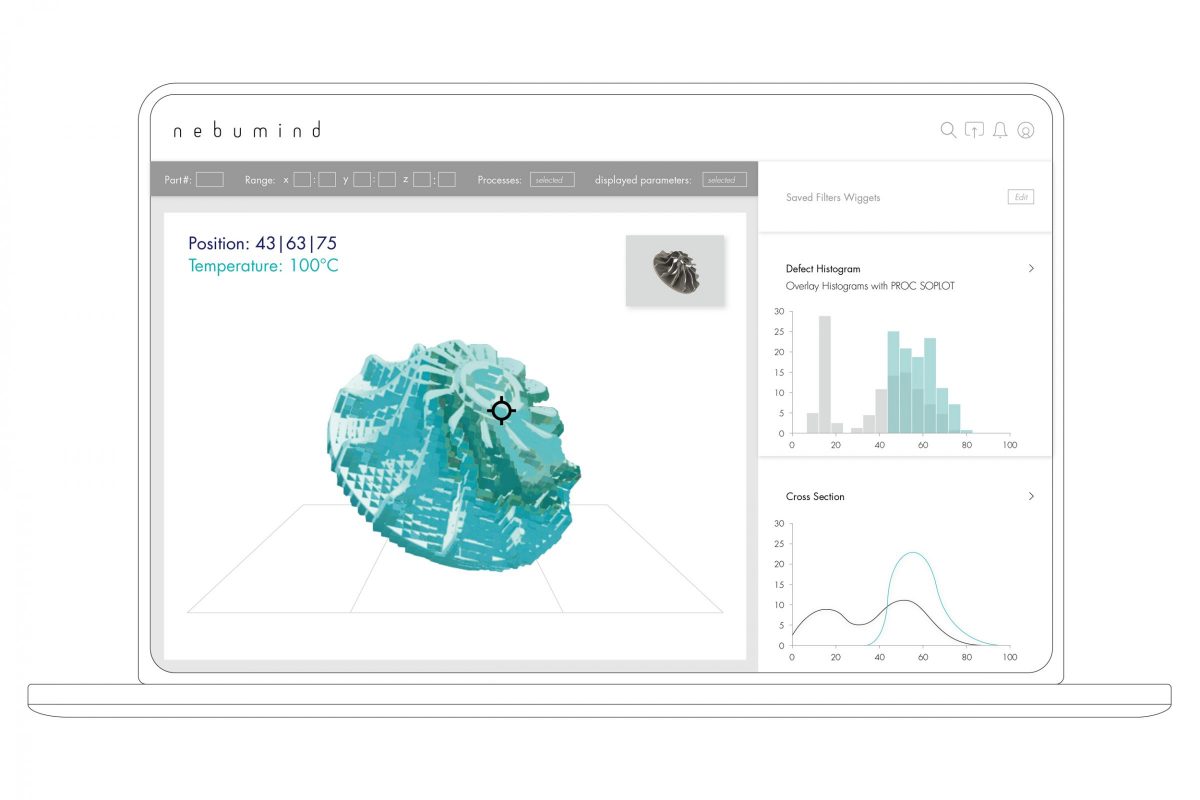
Nebumind develops software for productions that monitor the quality of components throughout the entire production process The software collects all production data that it can retrieve from machines and sensors during the manufacture of a component and uses this to create “digital component twins” that the worker can view on their laptop. They can see at any time which production information is available for a specific location (x, y, z) in the component. This means that questions such as “Why do I have a defect in the top right corner of every 5th component?” or “If I increase the speed of the machine, will that affect the quality of my component?” can be answered quickly. Nebumind therefore helps production companies reduce waste and production costs.
Munich Startup: But that's been around for a long time!
Caroline Legler: At first glance, this may seem so: More and more software solutions are coming onto the market that collect and analyze production data. However, these solutions focus on efficient production logistics or high machine utilization. We have not yet found any software that focuses on the quality of manufactured components and can also monitor them throughout the entire production chain, regardless of the machine or manufacturing process involved. This is exactly where we come in with our software and our manufacturing knowledge.
Munich Startup: Has there ever been a point where you almost failed?
Caroline Legler: Originally, we planned to found Nebumind as a team of three, but our co-founder at the time decided to pursue other avenues before the company was founded. Since he was primarily responsible for our software development, this was quite a blow. Good software developers are notoriously hard to find. Fortunately, we were able to find a perfect successor from our previous network, who now provides us with excellent support.
“We are absolutely convinced of our solution and are eager to bring it to market!”
Either way, we can say: Even when it was uncertain how we would proceed, we were clear that we would continue. We are absolutely convinced of our solution and are determined to bring it to market!
Munich Startup: How are things going?
Caroline Legler: In times like these, we can consider ourselves fortunate—despite the coronavirus pandemic, we can continue working on our pilot projects with relatively little restriction. We are currently particularly active in the area of space production. We are receiving very positive feedback, not least due to the high quality requirements for satellites and rockets. We are also in discussions with production companies in the aerospace, automotive, and medical technology sectors. In the aerospace sector alone, our software is relevant for approximately 70,000 machines, so we have a lot to do!
Munich Startup: How do you rate Munich as a startup location?
Caroline Legler: Munich may not be the most favorable location for young startups, but it has developed very positively in recent years. Bavaria offers numerous funding programs, new networks for startups are emerging in and around Munich, and investors are also increasingly turning their attention to Munich. For us, the proximity to industry and research institutes (e.g., the Fraunhofer Society or the German Aerospace Center) is particularly important, as is the proximity to the excellent universities here in Munich, where we are always looking for new employees.
Munich Startup: Coworking or your own office?
Caroline Legler: After setting up our office in the Motel One Lounge for the first six months and spending the last few months in coworking spaces, we are now happy to have our own office again, which we can design ourselves and equip with all kinds of IT gadgets.