
Blackwave aims to revolutionize the lightweight construction market. To achieve this, founders Raphael and Basti are relying on a very specific manufacturing technology that allows them to deliver highly complex carbon components to their customers. The Munich-based startup certainly can't complain about a lack of demand. The founding team revealed this and much more in our 7 questions.
1. Who are you and what do you do? Please briefly introduce yourself and your startup!
We are the team of BlackwaveRaphael and I (Basti) (30 & 29 years old, mechanical and aerospace engineering) met in 2010 at the Formula Student competition at the Technical University of Munich. For those who don't know, Formula Student is a student competition in which university teams from around the world work on a racing car and compete against each other on the racetrack with their developments.
Even back then, we refused to write a scientific paper just for paper and filing away. Therefore, together with Airbus and the Chair of Carbon Composites, we decided to develop a lightweight wheel rim for our team. We also wanted to use a manufacturing technology that was still unknown at the time: Carbon Sheet Molding Compound (C-SMC).
Employees wanted!
The result ultimately received such a positive response that we decided to found Blackwave and commercialize our knowledge. As Blackwave, we have continuously developed this technology and now offer our customers series production of highly complex carbon components.
A lot has happened since our founding in April 2016: We have investors on board, are working on projects for renowned clients, and now have eight employees at our nearly 1,300 square meter company premises in Taufkirchen. Things are currently going very well, so we're already looking for new employees who are interested in shaping the lightweight construction market of tomorrow with us.
2. But that's been around for a long time!
SMC is actually a technology that has been used since the 1970s. Driven by the oil crisis, automobile manufacturers were looking for a way to reduce the weight of primarily heavy trim parts. However, this still involved processing glass fibers and polyester, and the components were installed on large vehicles such as trucks. We, on the other hand, use carbon fibers and high-performance thermosetting plastics, hence the name: Carbon SMC. This gives the components significantly better mechanical properties and opens up entirely new fields of application for which there were previously no satisfactory solutions.
“Our process is highly automated”
We've experienced a kind of renaissance of the SMC process in recent years, as it's becoming increasingly important to produce carbon fiber-reinforced components efficiently and in large quantities. This is where our advantages clearly shine: Our process is highly automated, extremely cost-effective, and generates virtually no production waste, thus solving several problems of conventional carbon manufacturing technologies at once. Another key advantage is that we can easily produce components with very complex geometric shapes.
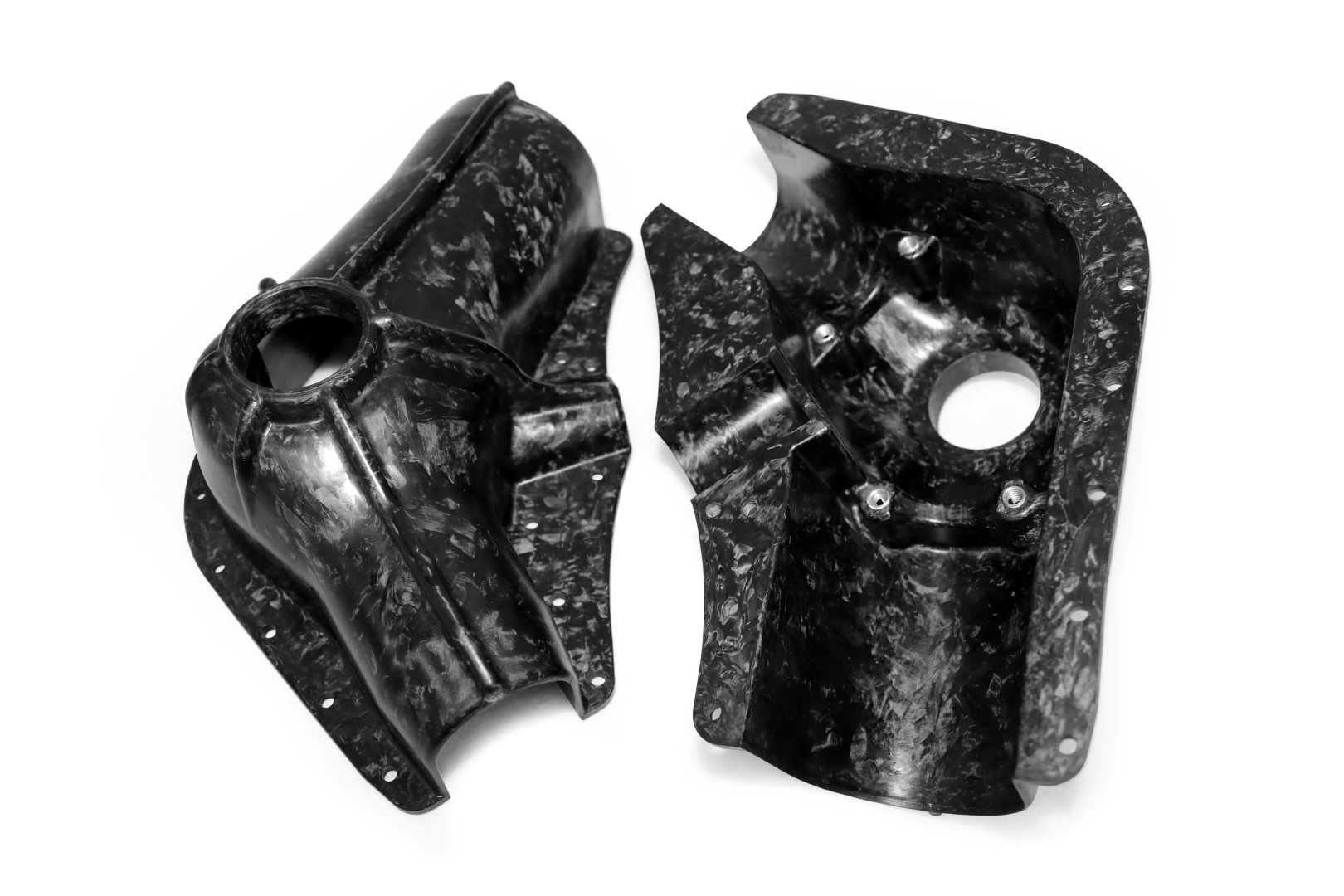
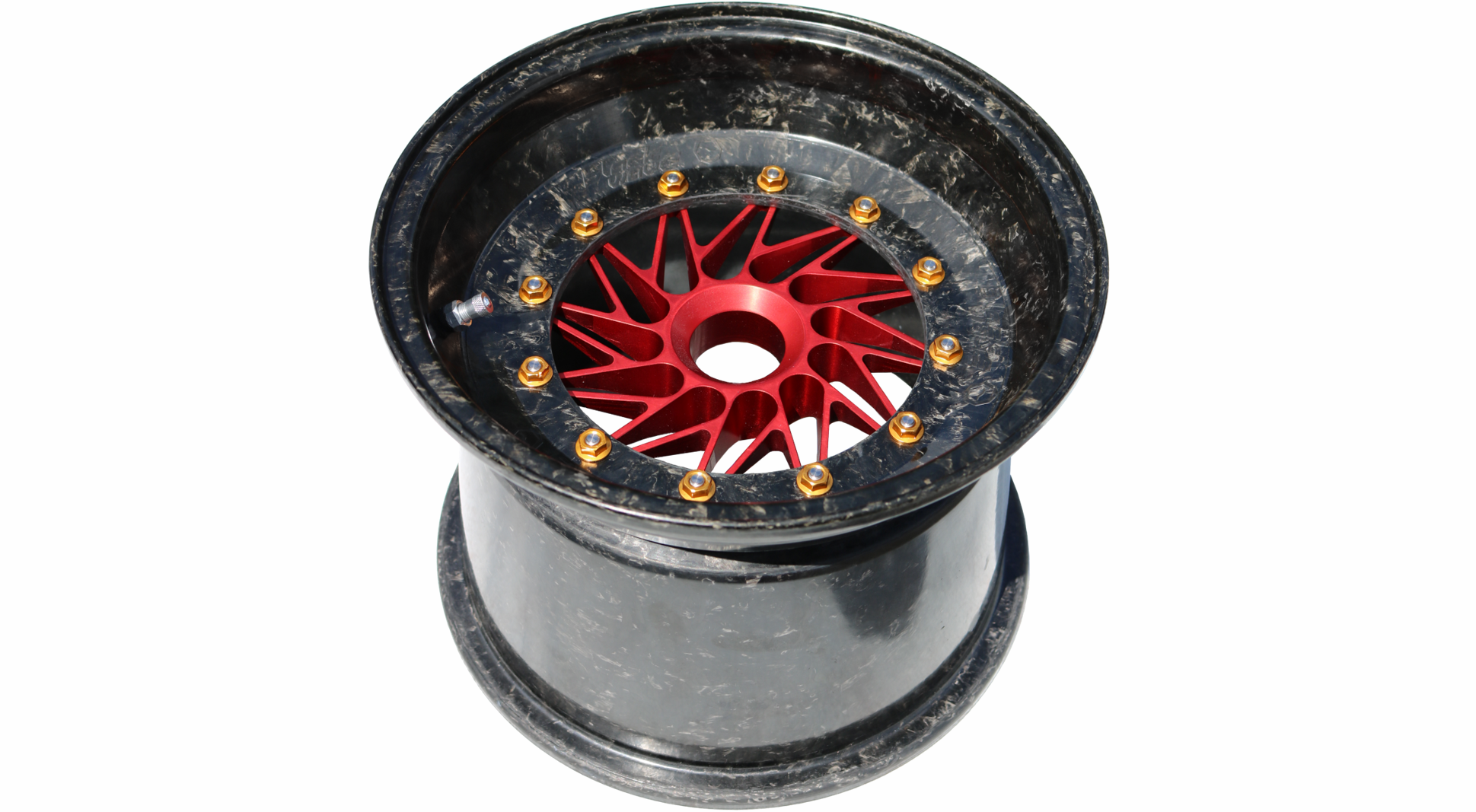
Conventional carbon processes are severely limited here, as traditional woven mats are limited to simple, flat geometries. To give you a better idea: We process a molding compound that, unlike traditional woven mats, doesn't have to be inserted layer by layer into the tool, but is instead portioned into the mold. Under high pressure and temperature, the material flows and completely fills the mold. Ribs and wall thickness transitions that were previously unthinkable can now be achieved in our molds in no time. Once our molding compound has cured after two minutes, it has properties that rival those of titanium.
3. What are the three main ingredients for your recipe for success?
- An open corporate culture and the way of dealing with mistakes
- The love for efficient lightweight construction
- As many Formula Student alumni as we can get
Focus is on large-scale projects
4. Let’s get down to business: How is business going?
With our move at the beginning of the year, we significantly expanded the capacity of our infrastructure and, of course, subsequently drummed up a lot of publicity. As a result, we're currently experiencing so much demand that we've even had to slow down the rotation speed of our advertising a bit.
We are currently concentrating primarily on markets where we see both the greatest growth potential and a strong need for outstanding lightweight construction. We are therefore primarily working on larger projects for manufacturers of premium vehicles, in the sports equipment industry, and in the aerospace sector. This year, we plan to further industrialize our technology and establish the processes for series projects. The first major series is scheduled to launch in 2019. By then, we plan to have 15 permanent employees. In any case, we are absolutely thrilled to soon be able to present the first components from our projects to the public.
There is no better location for our project than Munich
5. What does Munich mean to you?
For our plan to revolutionize the lightweight construction market, there's simply no better location than Munich: We have so many customers from a wide variety of industries right at our fingertips that we don't even know where to begin. We also quickly found investors here who believe in us and support us with advice and support in our project.
Not to mention the fantastic entrepreneurial spirit of the Technical University of Munich, which supported and encouraged us throughout our journey to build our own company. And then there's the issue of young talent: with so many top universities, we're naturally well-supplied with dedicated young talent. And when we finally call it a day, we can cool off in the Isar River so we can get back to work the next day.
Defending our pioneering role — expanding growth
6. How can your startup become the next unicorn? Or see you soon at Epic Fail Night
To advance the mobility megatrend, which is currently on everyone's lips again, efficient lightweight construction technologies are essential. The lightweight construction market is naturally highly competitive. Lightweight construction technologies compete with each other, as do different companies. However, we firmly believe that with our technology, we have chosen a promising material and a superior process.
Our advantage is that much of the potential for metallic materials has already been fully exploited, while our technology is only just beginning to realize its full potential. If we manage to defend and expand our pioneering role, the opportunities for further growth are excellent. Therefore, we will definitely continue to pursue our vision of becoming the premium partner for complex carbon components.
7. Helles or Prosecco?
Has anyone here ever answered Prosecco? Light beer, of course!

