There are countless methods in the area of "time management." But which ones are most important for startups, and which books can help founders increase not only their efficiency, but more importantly, their effectiveness? Guest author Dennis Fischer from 52 ways presents four time management guides that every successful founder should read.
I've been working on perfect time management for over ten years. I've read pretty much every book on the subject and experimented with countless methods and tools myself. At the same time, I've worked at two startups myself and coached several others over the past few years.
I would like to introduce you to the most important tips and tricks that have emerged from this, as well as the four best books for you.
1) Goals are better than any time management
Do you sometimes feel like too many tasks are piling up on you and you don't know where to start? I can assure you: Every founder feels this way!
Should I tell you what separates the successful from the less successful? They first set very specific goals and then set tough priorities.
Do you work with monthly/weekly/daily goals? Do you always keep them prominently displayed above your desk, or do you only pull them out of the drawer when investors announce their arrival?
“If you don’t know the port you’re sailing to, no wind is the right one.”
(Lucius Annaeus Seneca)
The best result of setting concrete goals is that you'll be able to prioritize your to-dos much better. You'll notice that while the mountain of tasks ahead of you won't get any smaller, it will be much easier for you to start on the "right" things.
For this purpose, the well-known “Eisenhower Matrix"It's proven effective. I first compile my most important tasks for the week on a list and then transfer them to the Eisenhower Matrix shown below. This allows me to put the individual tasks in relation to one another and distinguish between the truly important and the merely urgent.
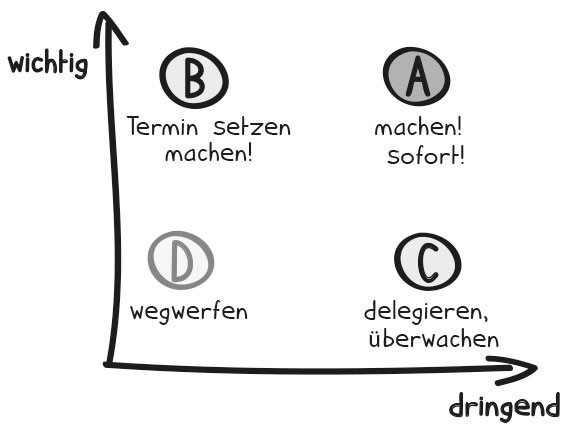
The next step is to include the "A" and "B" category tasks in my weekly schedule. I usually complete the "A" tasks immediately. For the "B" tasks, I take my calendar and set fixed deadlines. This prevents my calendar from being eaten up by smaller "C" or even "D" tasks, which might be more enjoyable in the short term but won't bring me any closer to my goal in the long run.
 Both topics (goals and prioritization) are discussed in detail in the book "The 7 Habits of Effectivenessby Stephen R. Covey However, this global bestseller covers numerous other topics that define successful people, which is why it is my absolute favorite book and my best recommendation for you.
It's not a book that you can read through in an hour; you have to set aside some time for it and do the exercises described.
You will find out where you can find this time in the next section.
2) The early bird catches the worm
Another characteristic that all successful founders have in common is the so-called morning routine. The book "The 5 AM Miracle“ opened your eyes. You don't necessarily have to get up at 5 a.m., as I've been doing for the past few months; it's about finding your personal "5 AM."
So if you have always gotten up at 7 a.m., try tomorrow at 6  Get up at 10 a.m. In this one hour, you establish a daily routine that, free from everyday stress, will help you move forward in the long term. For example, you can use this time to stay physically fit by going for a run or doing yoga. You can focus on your personal goals or the goals of your startup and take care of long-term issues.
You can also use the time to read the books recommended here and learn from the mistakes of other successful people, thereby saving yourself a lot of time in the long run.
If you absolutely can't manage it in the morning, try taking some time before bed at night, even if it's just 30 minutes a day. That's almost 180 hours a year that you're investing in your progress!
3) Getting things done
Now you might be asking yourself: "Visions and goals are great, but my problem is everyday life. I keep neglecting tasks and my inboxes are overflowing. How can I get better at this?"
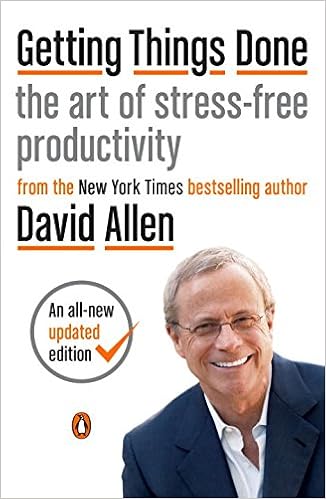
One of my bibles regarding the topics of “self-management and productivity” is the book "Getting Things Done“ by David Allen. The most important lesson of this masterpiece is to write everything down. This means jotting down everything that pops into your head and filing it away in your system. This frees up your mind for new (and more important) thoughts, and you're not spending the whole day thinking about a presentation you want to create in the evening.
You probably know the case where something keeps coming into your head because you haven't written it down anywhere and haven't defined the next step in the matter?
This is exactly what you can avoid if you work with a system that you trust and that you can use exactly when it's appropriate.
David Allen presents some excellent tools for this, which have now found their way into numerous apps. I personally use Todoist and I'm very happy with it. You can quickly create your to-dos, assign them a deadline, and file them in the appropriate folder. Wunderlist works similarly, but its design is a bit simpler, its use is more intuitive, and the free version is therefore better suited for beginners.
4) “Deep Work” or why less is often more
Cal Newport describes in his book “Deep Work"There are two types of work we can do. Either cognitively undemanding, logistically focused tasks, often performed under distraction. These activities tend not to create much new value in the world and are easily replicated. These include, above all, emails and social media, but also inefficient meetings and research.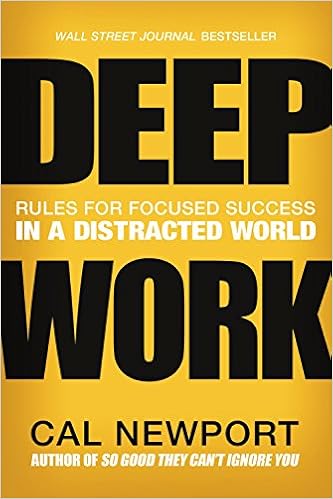
Newport defines "deep work" as the opposite: professional activities performed in a state of distraction-free concentration that push your mental capacity to its limits. This performance creates new value, enhances your skills, and is difficult to replicate.
As you can imagine, you should spend as much time as possible on "deep work." I know from my own experience that it's often not possible to delegate all organizational and administrative tasks in a startup, but once your company is past the initial phase, you should try to delegate as much administrative work as possible to working students, interns, or virtual assistants.
At the same time, you should of course also structure your daily routine so that you're not distracted every 10 minutes. You don't have to check your various inboxes every 30 minutes; it should be sufficient to go through your inboxes (email, social networks, messengers) and respond to your messages 3-4 times a day.
Don't spend too much time on useless websites. To overcome my own (completely normal) mental weakness and avoid wasting time on Facebook, YouTube, or other channels, I use the Chrome extension "StayFocus". It denies you access at pre-set times. Since then, for example, I've only been reachable on Facebook in the afternoon!
Even if you read just one of the books mentioned by the end of the year and implement some of the ideas, your effectiveness will increase dramatically in the coming months. I've seen numerous startups come and go over the past few years, and believe me, the ones that are still around and doing very well are led by founders who followed the above tips from the very beginning.
About the author
 My name is Dennis Fischer, I am a partner at methodworks and I am passionate about consuming business guides.
So that you can spend more time on the beach and less time choosing the really interesting guides, I recommend you to www.52ways.de Every week a free book that you absolutely should read.