Whether at Mobile World Congress, CeBIT, or SXSW: The Internet of Things (IoT) is currently one of the hottest digital topics. What a successful IoT solution can look like is demonstrated by tado°The Munich-based startup teaches heating and air conditioning systems how to think and, in the process, proves that, when implemented correctly, networked products are far superior to their analogue predecessors.
Who hasn't experienced this: We come home during the cold season and the apartment is freezing cold. It can take a while to get our four walls up to a comfortable temperature. Those who are particularly cold solve the problem very pragmatically and leave the heating on even when no one is home. However, this solution isn't just bad for our own climate karma – it also has a significant impact on our heating bill. In warmer climes, the same problem occurs in the summer: The air conditioning takes some time to bring the overheated apartment down to a bearable room temperature.
The smart heating
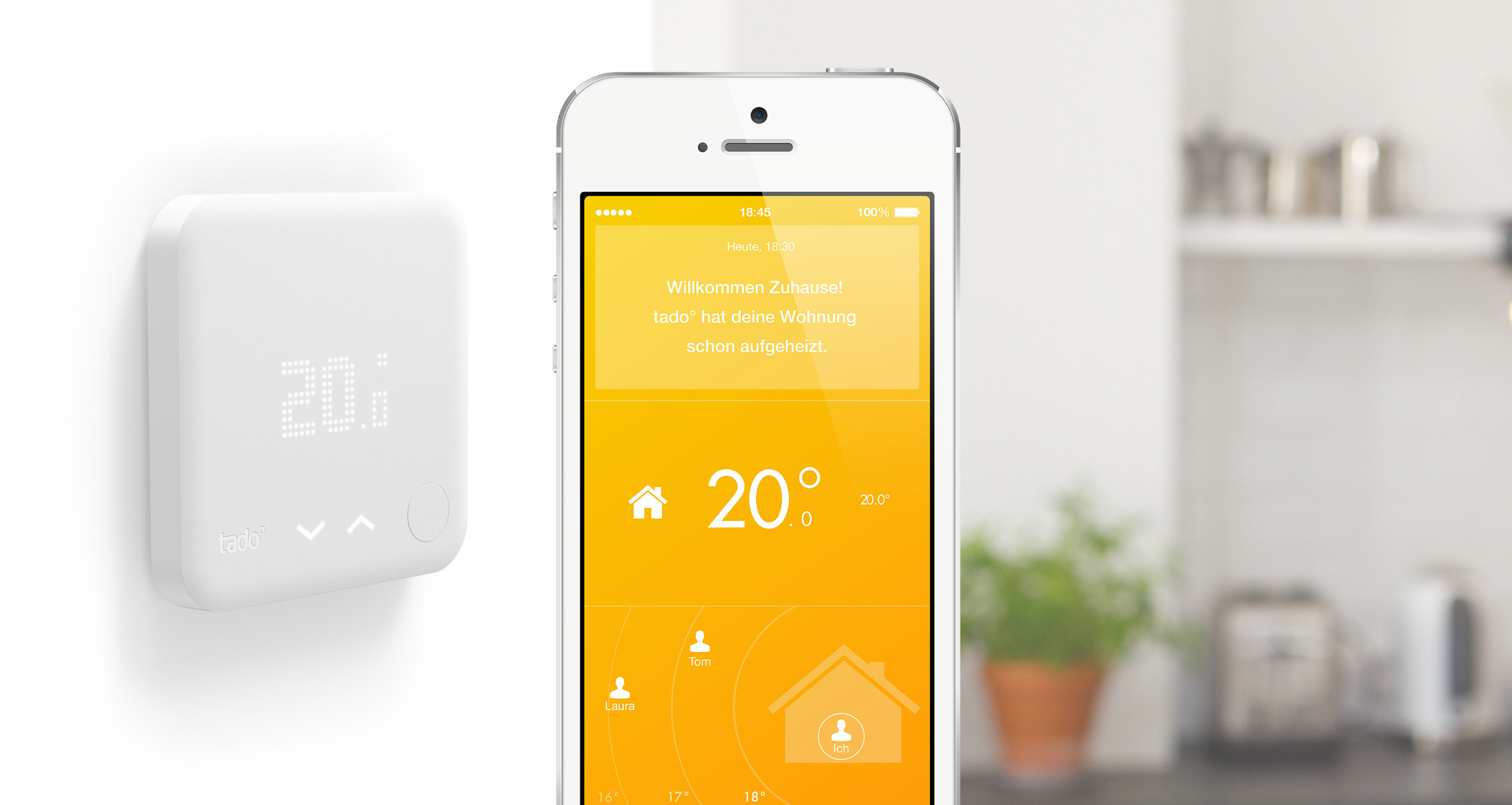
tado° has the solution: The tado° app collects data about its users' needs and links it with publicly available information such as weather data. An algorithm processes this knowledge and controls the heating and air conditioning systems based on it. In practical terms, this means: The app knows when the last resident left the house and turns down the heating. If a resident is on their way home from work in the evening, tado° heats the apartment depending on the expected outside temperature. All of this happens automatically; the user doesn't have to worry about anything. The best part: The smart heating is not only comfortable, rather also saves money. Private households could save several hundred euros annually, according to tado° CEO Christian Deilmann in an interview with Munich Startup.
Like all IoT solutions The system is based on the use and processing of data. With user consent, installers receive operating data, such as water pressure or heating system error codes, via a remote maintenance portal. The technicians can then contact customers directly, inform them of the malfunction, and order suitable replacement parts.
For tado°, the theme Data security This is a high priority: To protect the processed data, the system uses the same security standards as online banking. No information will be shared with third parties without consent. Deilmann explains:
"We handle the collected data with care. It's important to us that our customers can trust us completely, just as they trust their doctor or their bank."
IoT as a megatrend
In the Internet of Things, Deilmann sees a Megatrendthat will directly impact our lives:
"Networked products are far superior to conventional ones And technology is becoming increasingly affordable. Whether it's a car, heating, or alarm system – many things in our everyday lives are becoming online products."
The trend is also reflected in the Business figures tado° currently generates eight-figure revenue, increasing it by 350 percent last year. The company employs approximately 100 people and is present in twelve European countries. Recently, a sales partnership with o2 in the UK and AT&T in the US was established.
Every beginning is difficult
Six years ago, tado° began: Christian Deilmann came up with the idea while studying at MIT. Back home in Germany, he brought Johannes Schwarz, a fellow student from Technical University of Munich, Valentin Sawadski, and later Leopold von Bismarck came on board. In 2010, the team tested the first prototypes in their own homes and founded tado° the following year. Initially, the founding team invested their personal savings. It quickly became clear that they would need to dedicate themselves to the project full-time, so they quit their jobs. Initially, the founders didn't pay themselves any salaries. To finance product development, the young entrepreneurs sought public funding and venture capital:
"It was a huge step for us to give up our jobs. At some point, of course, things get tight financially. If we hadn't gotten anything then, we'd be out of luck."

But things turned out differently: EXIST promised a start-up grant and Deilmann’s former employer Target Partners offered venture capital The team was spoiled for choice, as secured financing through venture capital meant exclusion from EXIST funding. The result of the deliberation:
“We decided against EXIST and in favor of venture capital because it offered us a faster growth path.”
However, money alone is not everything – the support from the Munich network was invaluable for the founders:
"There are great contacts and mentors in Munich that you can turn to. What helped us a lot were the two startup networks LMU Entrepreneurship Center and UnternehmerTUMThey provided us with free offices, we reviewed our documents together, and refined our pitches."
As a side effect of working with the networks, says Deilmann, the founders were also able to build the necessary self-confidence.