VerbaVoice – that's the name of the technology company located in a round office building in eastern Munich. Founded in Munich in 2009, the startup developed a cloud-based platform to support people with hearing impairments.

In an interview, Michaela Nachtrab talks about the challenges of being an entrepreneur – and being a mother at the same time.
Michaela Nachtrab, together with her current husband and CIO, Robin Ribback, developed an innovative solution for the deaf or hard of hearing. The technology helps hearing-impaired people see content they cannot hear in real time.
The written and sign language interpreters can be connected flexibly and from any location via the internet. This applies to live subtitling of events, to tablets for students in lectures, to sign language interpreters displayed parallel on the screen for conference participants, or to smartphones during doctor's appointments. The dynamic young entrepreneur denies the somewhat provocative question of whether Siri couldn't do this. For various reasons, as the conversation reveals.
“Munich is a very good place to start a business”
Certificates adorn the walls. The Hall of Fame testifies to the great achievements VerbaVoice has made in recent years. What has the startup Au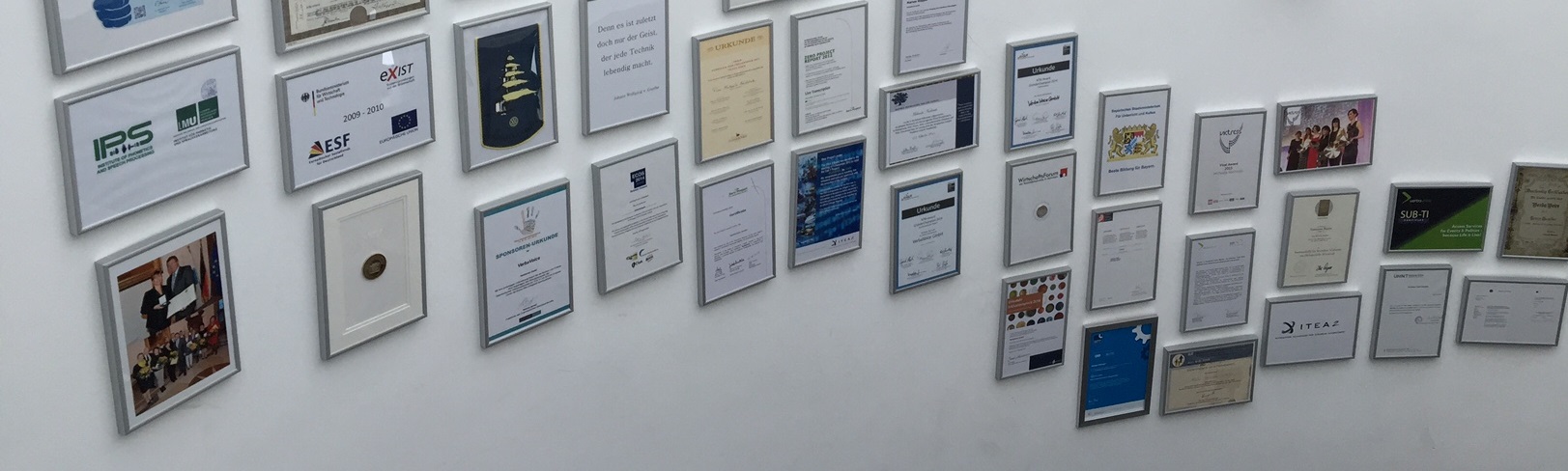 awards such as the KfW Award Gründerchampion Bayern, the German Innovation Award and the Inclusion Award Upper Bavaria?
Munich is a very good place to start a business because there are many funding and support opportunities, says Nachtrab.
Her path proves this: “For example, we are LMU and through the Exist scholarship, but also from BayStartUp I received good support. And I found one of our investors, Bayern Kapital, through a workshop at Werk1. The Social Venture Fund is our lead investor; we met them through an event hosted by a Bavarian foundation. I can only recommend that founders attend such events and take advantage of the Munich network."
The idea for VerbaVoice arose from her professional work as a deaf educator. There, she repeatedly noticed that certain areas were understaffed at certain times. With her solution, the founder addresses a bottleneck – there is a global shortage of text-to-speech interpreters. In 2008, Nachtrab wrote the business plan for VerbaVoice as part of her MBA studies.
 She developed the feasibility study together with the Phonetics Institute at LMU Munich. In 2009, she received an EXIST grant, which immediately supported the development of the prototype, which Ribback continued in his spare time while still working full-time, in collaboration with external developers.
Good partnerships are key
The founder first made contact with investors in early 2010, and the first financing round was completed at the end of 2010. With a finished prototype and initial sales, the founders had the necessary proof of concept. Several shareholders are now on board: In addition to Bayern Kapital and the Social Venture Fund, a French investment fund and two private investors have joined.
Her advice for financing: “Plan for more buffers in your capital requirements right from the start! This can offset slower growth or delayed technology development.”
In addition to the good network from the start-up scene, Nachtrab specifically built partnerships with existing companies right from the start. „What helped us most – good partnerships with established companiesBe it network, development, or sales partnerships. We work with a number of companies and organizations and benefit from their expertise or funding. Telefónica o2 has been a telecommunications partner from the very beginning and has also sponsored us."
The Babel Fish – more than science fiction?
Research partnerships with universities, the Fraunhofer Institutes, and Sony are also driving the young company forward. For example, VerbaVoice developed a new app for Sony's augmented reality glasses: This allows the wearer to view the speaker and simultaneously read the spoken word projected in space. This system can also translate fully automatically into a foreign language in real time, making it ideal for international conferences.
Michaela Nachtrab is visibly proud: "There's nothing like this anywhere in the world. Of course, there are still translation errors. We can have it translated and transcribed into foreign languages using online conference interpreters—of course, that's more expensive. We're still working on that."

French, Italian, Spanish, English, Chinese, and Russian are already available as technical solutions for the hearing-impaired and people with a foreign language background. Fiction becomes reality? The idea of a kind of Babel fish from Douglas Adams' "The Hitchhiker's Guide to the Galaxy" is a natural one.
A full schedule and then the nanny is missing: What's the truth behind the women's bonus?
The entrepreneur answers the question about the women’s bonus very clearly: “I would like to encourage other women to apply for competitions and grants specifically designed for women!”
Every bonus that is available should be taken, "...because as a woman, there are also natural disadvantages, such as childbirth and the time afterward. It's difficult and a burden, because you always feel like you're neglecting your child or your business. Most of the time, you think you're neglecting both." She was approaching 40 when she started her business.
“I enjoy building something”
She knows what she's talking about: Nachtrab's children were born in 2011 and 2015, during the initial and development phases. Is that something you want, can you achieve it? She says: "I have so much fun building something, watching it grow and develop. I don't know what I'd rather be doing instead." Being a founder and a mother at the same time – Michaela Nachtrab radiates so much energy, she seems to be made for it.
Your tip: „Start a business young and then have a child. Or vice versa. Doing both at the same time is very demanding and difficult to reconcile.”
Only with timely, professional help like a nanny and an au pair did Ribback and she manage, even during the difficult phases when they were involved in the company. And with a lot of Improvisational talent and juggling skills: "Your schedule is jammed, and then suddenly the nanny isn't available. I simply brought my children to appointments. And when the baby was hungry, it didn't care about investors." They seem to have taken it easy, after all there are several investors on board.
Be social and (still) earn money
VerbaVoice manages to be both a social enterprise and a successful tech startup. The company has 60 employees, some of whom are hearing impaired—this is true inclusion. The company also boasts several relationships and the resulting children.
And how do you go from €10,000 in sales in the founding year to a planned turnover of €3.5 million to €4 million in 2016? The partnerships, the good network, the investors – that's part of the answer. Customer focus, the specific needs, and how they are met in a unique way are also part of the explanation.
Twelve permanent interpreters and a pool of 1,500 written, sign language, and foreign language interpreters from Peru to Vienna provide interpreting services for a currently primarily German-speaking clientele. In the education sector, there is a legal requirement and corresponding co-funding from government funding bodies, for example, for hearing-impaired trainees, pupils, or students. For the young company, this represents 551,448 thousand of its contracts.

In addition, there are events such as interpreting the online live stream for the German Bundestag or conferences where private and public organizers seek support with live visualization, especially in written language.
And what does the future hold?
In the future, VerbaVoice become even more international. On the one hand, expansion into additional markets outside the DACH region is planned for the next one or two years. On the other hand, the focus is on new technical solutions for multilingualism. In addition, there are plans to expand further into automation.
“The big vision is to have the permanent online interpreter for all languages and inclusion in your pocket,” says Nachtrab. The management team complements each other well: “I come from the social business corner, I think about how I can improve the world, what can I do with it. My husband, on the other hand, is a visionaryHe wants his visions to become technically feasible. If he could finish building the Babel fish tomorrow, he would start the next project the day after."
We are excited to see which science fiction ideas will become reality.