Companies don't care how cool your product is. They're not eager to change the way they do things. And they don't like spending money. You only have one chance to get them to do all of these things:
You have to make them aware of a problem that hurts them so much that they pay attention to you – and then prove to them that you can solve it. The 'pain' always essentially concerns money: Because companies want to be as profitable as possible, they're always looking for new ways to reduce costs and increase revenue.
In our experience, the formula that determines your sales momentum is:
Sales success = Perceived 'Pain' x Perceived quality of your solution
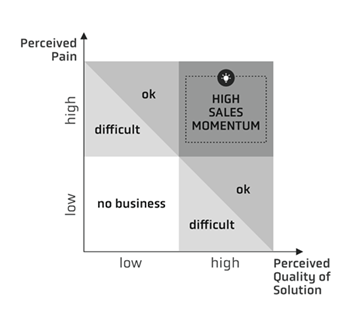
This results in three challenges that you must master one after the other in order to sell successfully.
1. Identify customers with sufficiently large 'pain'
It's easier to sell a painkiller than a vitamin supplement. Likewise, it simplifies your sales work when your customer's pain is clearly visible and quantifiable.
Sometimes the pain is hidden. The problem seems so unavoidable that it's not even recognized as pain. In this case, you have to get creative to first create awareness of the problem your product solves.
"We explained to our customers how our scouting solution saved them 8,000 hours of traditional supplier scouting. Impressive, right? But then they said, 'Theoretically, it's great, but we don't scout at all, so we're not saving any time.'"
Gregor Stühler, Co-Founder & CEO, Scoutbee

2. Clearly demonstrate how your solution can alleviate customer pain
As a founder, your superpower is to connect the pain with the product. Use this to your advantage in sales:
"As a founder, you can sell on a completely different level than a salesperson who can only change the product or the price. As a founder, you can change the rules if it helps close the deal."
Bastian Nominacher, Co-Founder & CEO, Celonis
If you sense that customers aren't seeing the connection, find out why: Are they not seeing the relevance of your solution? Perhaps the solution is missing something, or you need to rework your sales pitch. Or maybe the pain is less severe than you thought. Then it's time for a pivot!
You can provide the best proof of effectiveness by quantifying as precisely as possible how much money or time your solution saves your customers:
"A controller can clearly quantify the financial impact of a potential COVID-19-related plant closure. These risks can amount to several million euros. This makes it easy to demonstrate the cost-effectiveness of our product, which reduces both the likelihood and business impact of a COVID-19 outbreak."
Oliver Trinchera, Co-Founder & CEO, Kinexon
"On average, Demodesk helps cut the ramp-up time for a B2B sales rep in half, from six to three months. This means new sales reps reach their quota three months earlier."
Veronika Riederle, Co-Founder & CEO, Demo desk
3. Prove the superiority of your solution as a 'painkiller'
If there's a real and sufficiently significant pain, and your product solves it, the only thing that can derail your sales efforts is a competitor addressing the same pain. Continuously researching, understanding, and measuring yourself against the competition is an important task that many startup founders neglect.
As a startup, having to prove the superiority of your own solution over established companies sounds difficult. But it's doable – even as a group of students trying to build a rocket startup:
"It was a huge credibility boost for us to have Bülent Altan, former vice president of SpaceX, as an investor. That's a name everyone in the industry knows and trusts.
Daniel Metzler, Co-Founder & CEO, Isar Aerospace
Just by announcing our letter of intent with Airbus, we received 15 calls from satellite companies within two weeks about our satellite launches. Their reasoning was: If Airbus has done its due diligence and trusts these people, we can certainly trust them."
If you fail to convince your customers in these three steps, you won't have a chance of making a sale. If, on the other hand, you excel in all three steps, your startup will soon be able to celebrate sales success.