Compared to May, the Bitkom-Ifo Digital Index rose by 5.9 points – the highest value since the survey began in January 2006. Economic barometer is calculated from the geometric mean of the values for the business situation and business expectations in the digital industry. The actual business situation increased by 7.0 points from 40.6 to 47.6 points in just one month. Business expectations for the next six months increased by 4.7 points from 28.8 to 33.5 points.
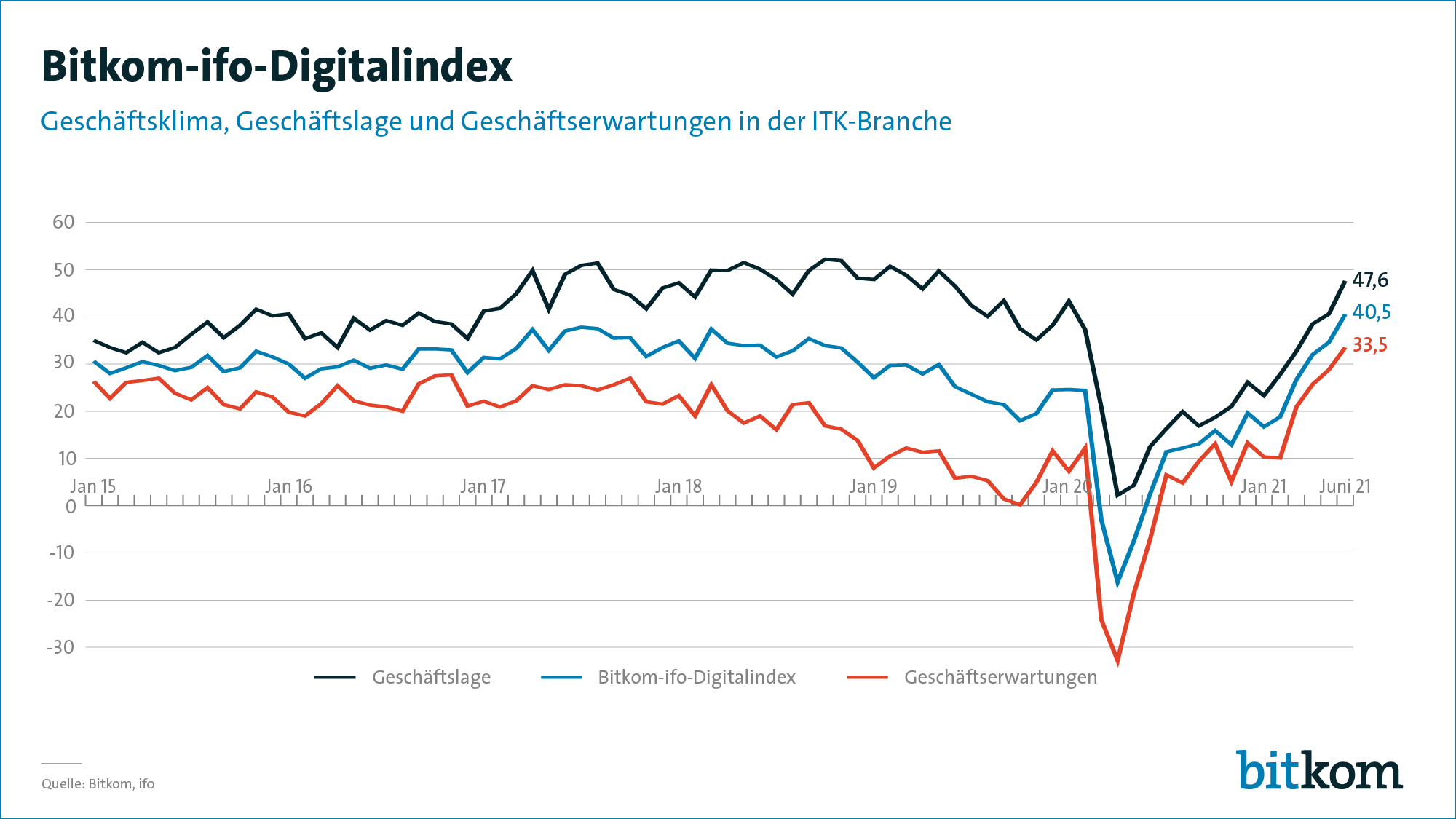
“Growth in the core of the digital economy is at its strongest in 20 years and sales are significantly above pre-crisis levels,”
says Bitkom President Achim Berg. The positive development in the labor market is particularly encouraging, says Berg:
“This year, the Bitkom industry in Germany is expected to create over 40,000 additional jobs, employing 1.27 million people in Germany.”
The signs point to growth in the coming year as well: According to forecasts, the market is expected to grow by 3.4 percent to €184.3 billion in 2022. At the same time, the number of jobs in the sector could rise to over 1.3 million for the first time.
“In addition to the record values, there are also uncertainties,”
says Berg.
"The emergence of new coronavirus infections, a possible fourth wave, the uncertain outcome of the federal election in the fall, and the ongoing shortage of semiconductors make the current situation fragile, and the economic outlook remains tense."
“The coronavirus crisis has shown that flexible working does not reduce the quality of work results.”
When asked how long they expect restrictions on public life to continue as a result of the coronavirus pandemic, digital companies, like companies in the economy as a whole, consistently stated a period of around six months. However, the Bitkom surveys reveal some differences between the digital and the general economy: Currently, just over one in five German companies is still relying on short-time work. Among digital companies, the figure is just 9 percent.
Almost two-thirds of employees in the ICT sector currently work entirely or partially from home. In the economy as a whole, the figure is less than half that, at 28 percent. Slightly more than half of the workforce would like to continue working entirely or partially from home after the pandemic.
"The Corona crisis has shown that flexible working does not diminish the quality of work results – on the contrary. Working independently of time and place can bring benefits to all parties,"
says Berg.
“A large number of digital companies have recognized these advantages and are taking advantage of them even without legal requirements.”