The Munich-based startup Talentry offers a cloud-based recruitment marketing platform. We spoke with founder and CEO Carl Hoffmann about how Talentry grew from a student startup to a young company with more than 50 employees, why trust and luck are important, and what the path to becoming a unicorn might look like.
The recruitment marketing platform from Talentry helps companies ensure that recruiting departments act like marketing and sales professionals, building an employer brand and thus addressing potential candidates, inspiring them to join the company, and attracting them more quickly. Talentry also aims to combat the shortage of skilled workers with this idea. With the Munich startup's cloud software, companies can also attract potential candidates and then stay in touch with them—automatically. Since employee referrals are a key element of recruiting strategies, the Munich startup specifically focuses on this channel and has digitized it: Employees simply share job advertisements on their social networks or directly recommend suitable contacts from their network for suitable positions.

But that’s not all, as Talentry CEO Carl Hoffmann explained:
"Employees act not only as recruiters, but also as brand ambassadors. In addition to job postings, they also share content via their social media profiles—for example, blog posts or press releases."
What's particularly practical for customers is that the reach generated by the content can be measured in shares and clicks. A new addition to the product portfolio is 'Candidate Relationship Management.' This enables companies to build talent pools, strategically cultivate relationships with potential candidates, and attract them to the company. The approach is comparable to 'Customer Relationship Management' in marketing and sales. And this is where the trend is heading in the recruiting sector, says Hoffmann:
"We develop such solutions in close dialogue with our customers. The need for relationship management tools is clearly noticeable, because traditional applicant management systems simply don't cover the recruiting process."
Focus on customers and trends
Close to the customer, close to the trends. This seems to be part of Talentry's recipe for success. One of its customers is also a successful young company, namely the Munich-based unicorn startup CelonisCelonis now generates 25 percent of all hires through employee referrals, Talentry founder Hoffmann tells us. When the Talentry platform was first launched, the figure was probably only 5 to 10 percent. But startups aren't the only ones using the solution. The founder cites the acquisition of major clients such as Henkel, Daimler, and KPMG as an important milestone. The clients are satisfied and express their satisfaction. Hoffmann explains:
“We have always been driven by the positive feedback from our customers, combined with the growing conviction within the team that we can build a truly large company in our segment.”
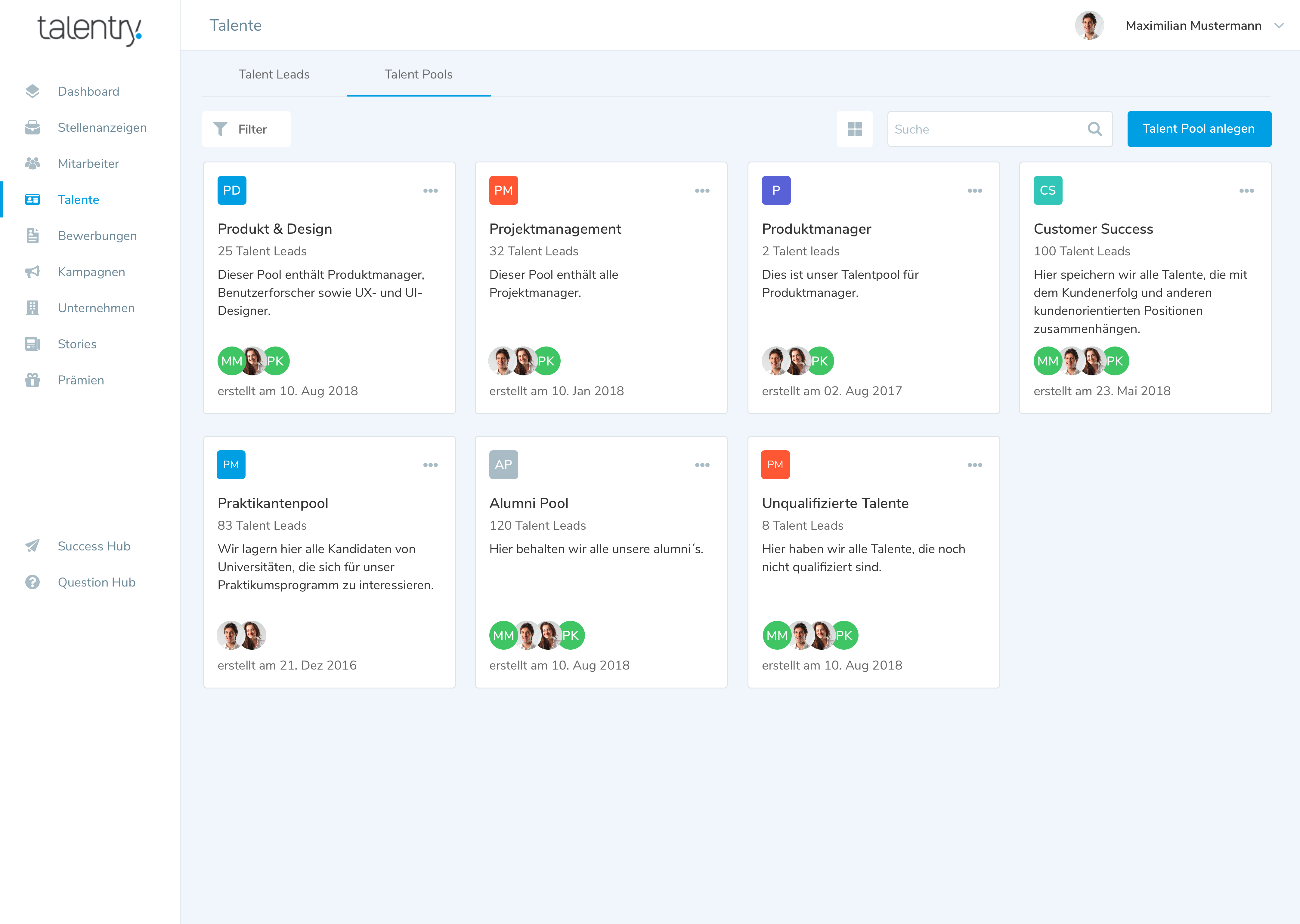
A lot has happened since Talentry was founded in 2013. The product has undergone significant development. The launch of Talentry CRM is certainly the most significant development, as it broadens the company's footprint and moves toward a platform solution. The number of employees has grown to 50, and plans to increase by another 20 by the end of 2019.
Financial injections, trust and know-how
But innovative product launches, increased staff numbers, and newly acquired customers aren't the only things that demonstrate that the Munich-based startup is doing well. Hoffmann also notes this in other ways:
“One hallmark of our success is the trust that renowned investors have placed in us.”
In 2016, the HR startup announced financing of €2 million from Global Founders Capital, Rocket Internet Capital Partners, and Picus Capital (primarily funds from the Samwer brothers). Another round followed in 2018. Financing round in the amount of 6 million euros, which also included Nauta Capital, the IT and personnel service provider Allgeier, and business angels such as Bastian Nominacher of Celonis. SAP Hybris founder Carsten Thoma is also represented on the strong advisory board, giving Talentry extensive access to knowledge from the enterprise software environment.
Talentry has described itself on occasion as 'one of the most successful European startups.' We asked Carl Hoffmann how he measures this. He says:
"We have achieved significant revenue growth over the past three years and have continued to expand our position in the HR market. For example, more than one in ten DAX-listed companies rely on our solutions, and we have also already acquired our first major international customers in a short period of time."
However, according to the company's CEO, the company's successful development is also based on other factors. In his view, this includes, first and foremost, the team, says Hofmann, adding:
"I see the size of the addressed market and the timing of why the world needs such a solution right now as a close second. The latter also has a lot to do with luck."
Too much gut feeling, too little data
Of course, things weren't always easy for the Munich-based startup. There were a few stumbling blocks on the road to success. The founders founded Talentry out of university with relatively little prior knowledge, and therefore needed some time to find the right product-market fit. Hoffmann shares a little insider information:
“Looking back, we initially listened too much to our gut feeling and collected too little data.”
Today, Hoffmann says, he would hire BI resources earlier and much more decisively, integrating business intelligence and data-driven analytics into his own company. The founder explains that different data should be collected depending on the phase:
"While the initial goal is to prove product-market fit, you should then focus on your unit economics, master them, and then scale in a controlled manner—for example, not hiring ten sales managers at once, but gradually increasing the frequency. Sales recruiting as a whole is a whole area in which we've made mistakes and learned a lot from them."
However, his ultimate tip for founders is:
“Focus in all areas — and learn to say no early on.”
Finally, we wanted to know how Talentry becomes the next unicorn. Hoffmann says:
“With a lot of hard work, perseverance and the necessary portion of luck.”