
A new, emission-free, hydrogen-based propulsion technology is being developed by the Munich-based startup Keyou. The founder had originally worked on the technology for a major automobile manufacturer. Several patents have been filed, and the Munich-based company has also found a seed investor. Our 7 questions to Tom Korn, founder and CEO of Keyou.
1. Who are you and what do you do?
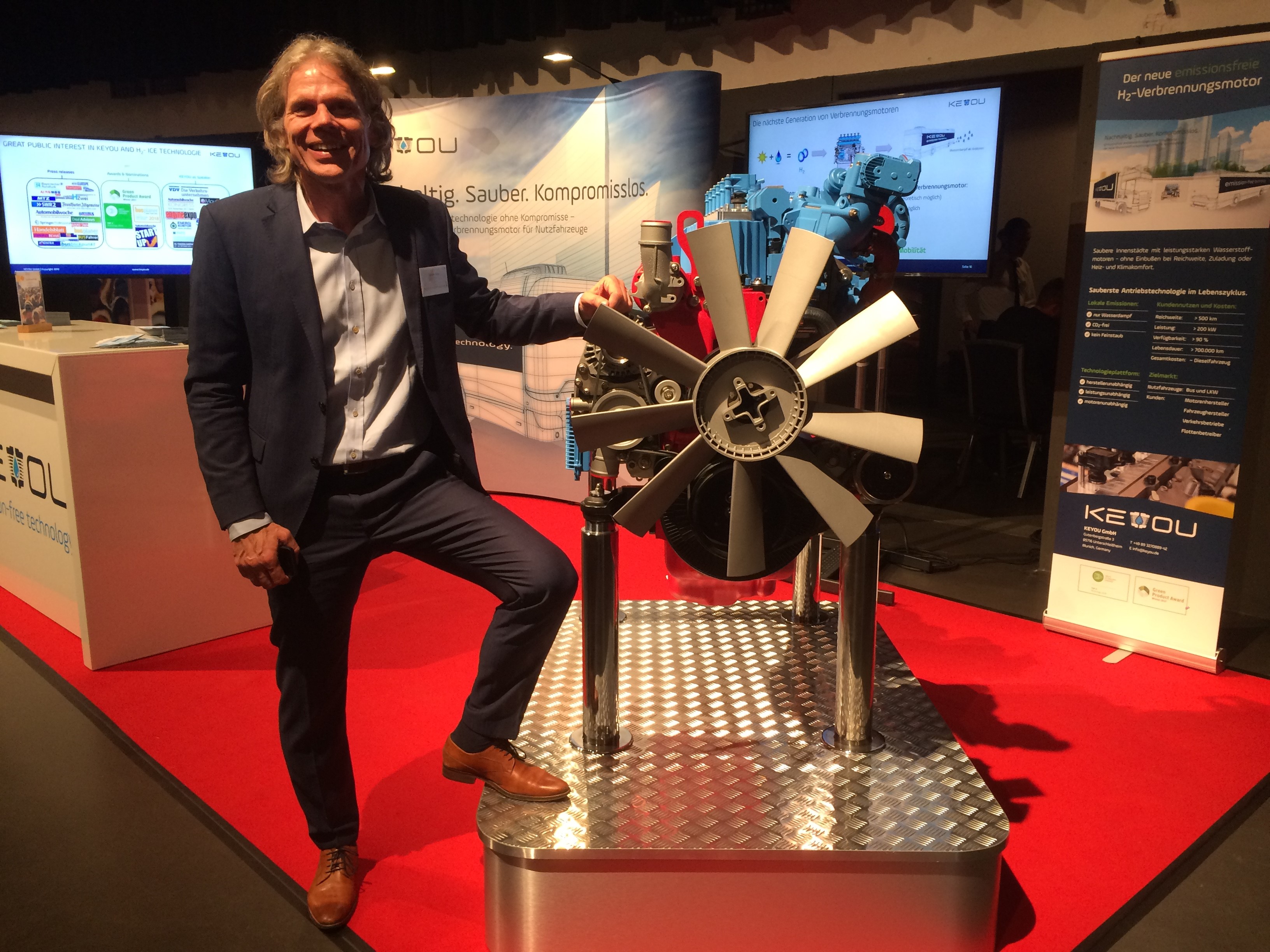
We are a young, high-tech company based in Munich that specializes in the development and marketing of innovative hydrogen technologies that can be used to produce emission-free hydrogen engines. Or to put it another way: Our technological approach enables us to transform conventional diesel and gas engines into emission-free hydrogen engines – without major modifications to the base engine. This ensures cost-effectiveness as well as scalability. Our technology is suitable for both on- and off-road applications.
Converting conventional engines into zero-emission engines
Our further development of the classic combustion engine to utilize hydrogen as a sustainable fuel enables a quantum leap in drive development. Efficiency and power density reach entirely new levels – and ultimately, the only exhaust gases released are harmless water vapor. The new 'green' combustion engine with 'Keyou inside' technology ultimately means zero emissions, efficiency, and cost-effectiveness all at once – without compromising on performance, capacity, or range. 'Sustainable Zero Emission' becomes a reality with Keyou, so to speak.
2. But that's been around for a long time!
The last technological wave of hydrogen combustion engines dates back more than ten years and was led by the German companies BMW and MAN. It's no coincidence that the technology was driven by German automakers with strong engine expertise. After all, no other country in the world boasts as many successful automotive companies that have been able to differentiate themselves and assert themselves in the fiercely competitive automotive market through technological leadership in powertrains.
As is often observed in the automotive industry, interesting technologies fail to reach the mass market because either the technology is not mature or the necessary market conditions were not present at the time. In the case of the hydrogen combustion engine, both factors were wrong in the mid-2000s: timing and technological maturity.
Robust zero-emission drive for commercial vehicles
With Keyou-inside technology, we have been able to overcome the serious weaknesses of the past in terms of efficiency and power density. In terms of avoiding pollutants and the greenhouse gas CO2, we achieve a level of quality that the EU Commission defines as a zero-emission drive in its 'Legislative Draft for Reducing CO2 Emissions from Commercial Vehicles'. In terms of robustness and service life, the hydrogen combustion engine is in no way inferior to its diesel counterpart. The cost structure is extremely favorable due to the simplified or even unnecessary exhaust aftertreatment.
Market conditions have also changed. Air pollution control and, above all, climate protection are now a high priority in politics and society. Cost-efficient drive systems that are also suitable for everyday use are becoming increasingly important. We see that the window of opportunity for hydrogen engines is opening, initially for commercial vehicles. This ultimately also applies to the passenger car sector.
Automotive industry insiders know that the second wave of technology often finds its way into the mass market. Automakers don't want to miss out on this trend.
3. What are the three main ingredients for your recipe for success?
1. Technology
2nd Team
3. Timing
4. Let’s get down to business: How is business going?
We gained our first strategic investor, NAGEL Maschinen- und Werkzeugfabrik GmbH, at the end of 2016. Since then, we've tripled our workforce, filed seven patent applications, and are currently in very positive negotiations with engine and vehicle manufacturers who want to integrate our Keyou-inside technology into their platforms. We're very pleased with this, and our investors have also reflected this.
Startups as drivers of innovation and growth are underestimated
5. What does Munich mean to you?
Home, the center of life, and proximity to customers. Furthermore, access to qualified employees and technology partners, but equally high costs and too little political support for startup companies. I think the importance of startups as drivers of innovation and guarantors of future growth is generally underestimated in German politics. There's a lot of talk about them, but ultimately, the focus is on the large, long-established companies.
For example, there are no tax breaks, and the issue of funding is highly bureaucratic and based on a long-term perspective. In my opinion, we here in Bavaria, and in Germany in general, have some catching up to do, especially compared to California or Israel. The region around Munich definitely has the potential to be the Silicon Valley of high-tech startups in Europe. But without genuine political will and support, it will take some time.
6. How will your startup become the next unicorn? Or will we see you soon at Epic Fail Night?
Technology, teamwork, and timing are crucial for market success. Keyou has all three of these in place. That's why we're confident we'll be reporting further successes soon.
“The best meetings often take place in the beer garden”
7. Helles or Prosecco?
We're an international team and, due to the nature of the industry, predominantly male. The best meetings often take place in the beer garden. Of course, we accompany them with a Bavarian beer and a touch of coziness. Our colleagues from Portugal, Luxembourg, Sweden, and England also love it – although the English often have to go home early... :-) You should know, most of us are also big football fans.

