Are you one of those people who always find themselves in the slowest line? The startup Rapitag wants to ensure that you never have to wait in line again. This is not only a huge advantage for Shopping Queen contestants under time pressure, but also for anyone else who doesn't like waiting. Founders Alexander and Sebastian reveal how it works.
1. Who are you and what do you do? Please briefly introduce yourself and your product!
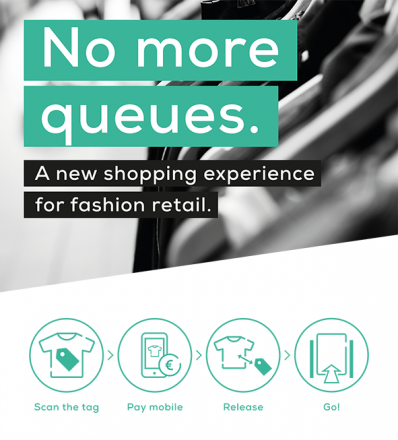
We, Alexander Schneider (32) and Sebastian Müller (31), want to eliminate checkout lines in brick-and-mortar retail. We are a young team of founders from Munich who run Rapitag GmbH and have invented an intelligent anti-theft device that can be removed directly by the customer. This creates a completely new shopping experience: The customer walks into a store, can experience the product live, and pay on the spot with their smartphone; there's no need to queue at the checkout. The device is removed after successful payment, remains in the store, and is reused. In addition to the hardware, the focus is on the mobile shopping app.
Convenient for the customer, secure for the retailer
 2. But that's been around for a long time!
You're probably familiar with the self-checkout systems at Ikea or some supermarkets (the latest concept is AmazonGo). The problem is, as soon as a product reaches a certain value, the risk of theft increases – for example, with fashion or consumer electronics. That's why there are no self-checkout systems in these areas yet. Furthermore, it makes no difference to the customer whether they have to wait in a traditional or self-checkout line. It's the same as with mobile payment: there's no real added value for the customer. It makes no difference to them whether they pay with cash, card, or smartphone if they still have to go to the central checkout. For the first time, we offer simplicity and convenience for the customer, combined with the highest level of security for the retailer.
3. What has been your biggest challenge so far?
In addition to hardware development, we're also contacting (German) retailers willing to run a pilot store. While the solution is generating widespread interest, no one wants to be the first to test it live. This would be a particularly good opportunity for traditional retailers to find a solution to e-commerce and a lack of customers—while simultaneously marketing their own store as extremely innovative in the media.
Rapitag plans pilot store
4. Let’s get down to business: How is business going?
We founded the company a few weeks ago and are currently receiving EXIST funding. Our seed financing round is closing, and the next milestone is a pilot store. The first hardware series is currently being produced and the software is being improved. After a pilot store, we plan to launch broadly. After all, we've already successfully patented the hardware.
5. What does Munich mean to you?
In our opinion, Munich is THE location for all hardware startups, especially in the early stages. While e-commerce and software startups dominate in Berlin, there's a vibrant hardware scene here, additionally supported by many companies and service providers. And although the cost of living is more expensive than in Berlin, for example, the city simply offers the best quality of life.
6. How will your startup become the next unicorn? Or will we see you soon at Epic Fail Night?
A few months ago, the answer would certainly have been more difficult, but things are currently going extremely well for Rapitag. The biggest motivation was winning the RID Foundation’s “Trade in Transition” competition and UnternehmerTUM. Furthermore, the collaboration with MediaMarkt/Saturn in the RetailTech Hub is culminating in a pilot store early next year, and we're also in talks with many (large) fashion chains across Europe and the US. In Germany alone, almost two billion euros are invested annually in theft prevention – and unlike our solution, this only has a deterrent effect and no additional added value. But whether we'll reach the annual number of three billion security devices worldwide remains to be seen.
7. Shop online or offline?
It depends on the product, but if in doubt, always shop offline. There's nothing like testing, touching, or trying on in person. Who wants to order three pairs of pants and then take two back to the post office?