What's behind blockchain? The magazine "Digitale Welt" asked Michael Eitelwein, Head of Corporate Architecture at the Allianz Group. He answers this question in a guest article, the one in Digital World Magazine appeared.
What is behind blockchain?
Imagine buying a used car with one click, transferring ownership, paying the purchase price, insuring the vehicle, and registering it with the authorities – all in a single step. The license plate would be delivered by courier the very next day. Blockchain is the first technology that could make this possible.
Technically speaking, blockchain is a distributed database that records transactions. It can be thought of as a digital, openly accessible ledger. Most ledgers today are maintained privately by trusted third parties, such as banks or clearinghouses, who ensure that all parties adhere to the business agreements and that the ledger is consistent.
Blockchain technology now makes it possible to maintain a ledger in a peer-to-peer network without the involvement of any of the aforementioned third parties. The ledger is distributed across all participating peer computers, and the blockchain's algorithms ensure the integrity and immutability of transactions without the need for dedicated oversight.
The transactions are forwarded to all participants in the peer-to-peer network. Cryptographic procedures ensure that the integrity of the ledger can be verified by everyone, but the details of the transaction are visible only to the parties involved. Until now, we have always kept our ledgers under lock and key. Now they are being made public – digitally.
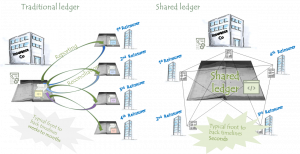
Transaction recording is crucial for the smooth running of business processes. Today, many transactions are still recorded in separate systems and require constant reconciliation between the various parties involved. This reconciliation is often still done manually and is therefore time-consuming and costly.
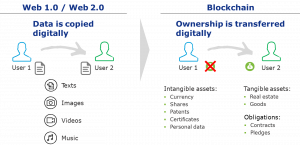
Blockchain makes it possible not only to conduct these transactions digitally but also to store them in a shared, distributed system. This eliminates the need for complex processes for reconciling separately maintained ledgers and inventories. Hence the hype surrounding blockchain: It stems from the expectation that it will trigger a new wave of digitization of business models, especially when it comes to ownership transfers.
What are the advantages of blockchain?
Blockchain will help improve the sales experience. The technology enables fully digital and transparent transactions, thus ensuring more convenient and faster business transactions.
At Allianz, we were inspired by this vision. We conducted initial trials to explore the benefits this could bring to our customers. Following initial proof-of-concept studies, we launched an initiative with industry colleagues, the Blockchain Insurance Industry Initiative (B3i).
B3i's first case study focuses on a B2B scenario for simplifying the administration and processing of reinsurance contracts. Such contracts are one of the options available to insurance companies to protect themselves against extreme risks, such as earthquakes or hurricanes. Often, many parties are involved in such a contract, and the direct benefit of blockchain is that the time required for contract processing is reduced to seconds. This makes for significantly faster and more convenient processes.
A promising building block for a digital world
However, the benefits of blockchain are not limited to increasing business efficiency and better serving customers. Blockchain can also reduce barriers to financial inclusion by providing a universal, tamper-evident system of digital identities. This is particularly relevant for emerging markets.
You may be among the 70 percent of the world's population who own land but lack legal recourse to assert their claim because government records are unreliable or, worse, unenforceable. Blockchain can create digital land registers that can reliably confirm your ownership because they are open, transparent, and tamper-evident. This presents enormous economic opportunities.
Perhaps you live in Germany and own solar panels to generate environmentally friendly electricity. Instead of feeding the energy back into the grid at a low price, you would eventually prefer to sell it to your neighbors at market prices. Thanks to blockchain, you could conduct such peer-to-peer transactions with your neighbors without the need for a third party to mediate.
The internet is a global infrastructure for efficiently replicating and distributing information. Now, blockchain algorithms are emerging as an IT innovation that promises a universal infrastructure for efficient and secure transaction processing. There are virtually limitless application possibilities available that are worth exploring.
The author

Michael Eitelwein leads the Allianz Group's corporate architecture, which uses a holistic architectural approach across products, organization, platforms, and data to align Allianz with the requirements of a digital future. Since 2013, this has increasingly included the introduction of new technologies such as Big Data, the Internet of Things, Natural Language Processing, and Blockchain.
He graduated with a degree in electrical engineering from the Karlsruhe Institute of Technology, gained start-up experience in the semiconductor industry in Silicon Valley, accompanied the globalization of the chemical industry as CIO and has worked for the Allianz Group since 2009.