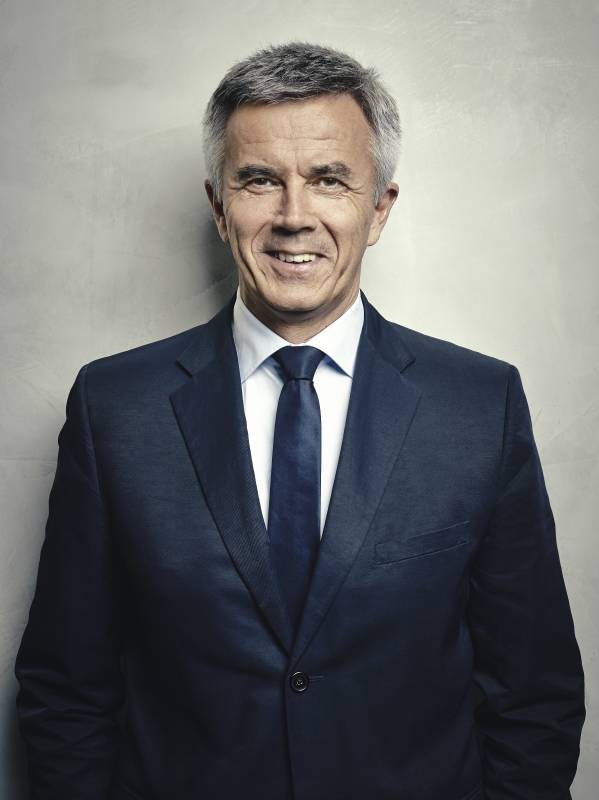
Peter Schwarzenbauer, Member of the Board of Management of BMW AG, MINI, Rolls-Royce, BMW Motorrad, Customer Experience and Digital Business Innovation BMW Group, is a fan of clear language. He's a good fit for a conversation about the future of mobility.
Mobility as we've known it for decades is undergoing a transformation. At MUST, you even mentioned that BMW is in a fight for survival that will determine whether the automaker will still exist in its current form in a few years. Does "mobility" need to be completely rethought? And in what different directions is BMW thinking?
The automotive industry is truly experiencing the greatest period of upheaval in its history. I am certain that the coming decades will bring us more changes than the past 100 years. The key question, and at the same time a question of faith in the automotive industry, will be whether mobility services will be as profitable in the future as selling vehicles. I see enormous opportunities for this. If, in addition to selling fascinating vehicles, we can also offer people mobility every minute in the future, and they no longer have to make large investments, then that is a fantastic prospect, especially for premium and luxury products. This approach opens up access to a completely new and very large customer segment. This could mean that our future business model could be even better in the long term than the current one. We have a clear vision of how many of our customers will be mobile from 2030 onwards: autonomous, electric, and fully connected. And we are already working towards this.
In your opinion, what role do startups play in this transformation process? And what is BMW doing to find suitable startups?
Startups often act as accelerators in this process, especially due to their completely different way of thinking. The scene thrives on the belief that anything is possible, and I am convinced that this boundless optimism releases an incredible amount of energy. Above all, startups are accustomed to thinking in terms of fast product cycles. This allows some young companies to show us, even as innovation leaders, how large companies can become more agile and implement things more quickly. Here at the BMW Group, we have a wide range of connections to this scene. For example, we invest over BMW i Ventures in the best and most innovative startups and at the same time support them with our know-how and our network as an established, global player. URBAN-X, our MINI Accelerator, we support startups that are committed to innovative concepts in urban areas. And through the Startup Garage We offer selected startups the opportunity to complete a special program lasting several months. The focus here is on developing a functional prototype with an application relevant to us.
“After all, top conditions for bright minds and new ideas should not only be found in Silicon Valley.”
Munich was recently declared a Digital Hub Mobility Are such cross-cutting initiatives necessary to remain internationally competitive? What does BMW hope to achieve with this interdisciplinary collaboration?
People's mobility needs are changing rapidly today. In the future, we will be able to offer autonomous, connected, and emission-free vehicles in cities, opening up entirely new mobility options. However, this also requires people to rethink and learn. We want to offer them alternatives for their personal mobility today that offer people an incentive rather than a sacrifice. In the Digital Hub Mobility, we are working towards this goal together with all players from the private sector, as well as partners from science and the public sector. In this way, we naturally also want to strengthen Germany as a whole as a center of innovation for mobility solutions in international competition. After all, top conditions for bright minds and new ideas cannot be found only in Silicon Valley.
Autonomous driving and electromobility – both big topics. With the iNext, BMW has already announced that it will launch a self-driving, connected electric car by 2021 at the latest. Where do you see the biggest challenges here? And will these cars already be seen in urban areas by then?
Autonomous driving is an extreme technological challenge, especially when you consider the pedestrians, cyclists, and public transport and delivery vehicles in a big city. Situations that we as humans handle intuitively must first be taught to a machine. This requires enormous computing power to process an incredible amount of data in real time. To paint a picture: we're talking about a data volume that, if burned onto DVDs, would result in a stack over 100 km high. Autonomous driving requires millimeter-precise navigation material, i.e., a fully digital representation of the surroundings. For this purpose, we, together with Daimler and Audi, acquired the map service provider Here from Nokia. Furthermore, when it comes to autonomous driving, we are pooling resources and expertise with Mobileye, Intel, and, more recently, Delphi. We are completing millions of test kilometers on the road for autonomous driving and simulating driving in the laboratory. The technology will gradually become noticeable in urban environments as well. With the BMW iNEXT, we will offer a highly automated vehicle, i.e., driving at Level 3, in series production starting in 2021. We will also offer fully automated driving (Level 4). Ultimately, however, we must not forget the human factor. Because you first have to be willing to trust a machine.
“With ReachNow, we are currently piloting a new dimension of individual mobility in the USA.”
With DriveNow, BMW is already the market leader in the German car-sharing business. Are there plans for a further foray into ride-sharing? And isn't there a risk that BMW will eventually become obsolete due to this sharing approach?
With ReachNow, we are currently piloting a new dimension of individual mobility in the USA that goes beyond pure car sharing. For example, ReachNow customers can book not only the vehicle but also the corresponding driver. We are also testing the delivery of a vehicle to the desired location at a desired time. In another pilot project, MINI owners can temporarily integrate their vehicle into the ReachNow fleet, thereby reducing their car's maintenance costs. ReachNow also offers residents of selected residential complexes exclusive use of a local vehicle fleet. We deliberately chose the USA as the pilot market for such new mobility offerings. If these projects prove successful, we will of course consider expanding them to other brands and countries. We generally do not view our mobility offering as an "either/or" but rather as a clear "both/and." We want to complement our core business with a highly attractive market. Because whether they have their own car or not, people will want to be mobile in the future too.
Prominent startup representatives like Frank Thelen never tire of citing Nokia's demise as a looming example of corporations that miss out on progress. Why won't BMW go under?
We celebrated our 100th anniversary last year and, I believe, impressively demonstrated with four visionary vehicles that we want to play a decisive and active role in shaping the future of mobility. We are defining the mobility of the future through autonomous driving, connectivity, electrification, and services. The iNEXT in 2021 sets the benchmark for our technological leadership. As a company, we are also constantly reinventing ourselves with these technological leaps and, despite all the challenges they entail, see them above all as a great opportunity.