
What is the ideal engine for a social vehicle? And what fuel does it need to run efficiently? Many social entrepreneurs are unaware of the wealth of options available to them, but there is a suitable financing model for everyone. It's time to explore the various options available to the social financing market.
But please don't forget: Even before choosing the right form of financing, there is the exciting question of what exactly you want from your future investors.
A guest article by Christina Moehrle, originally published on Blog Empowering People Network of the Siemens Foundation.
The right time for financing
When you talk to social entrepreneurs who have already successfully raised impact investments, several truths emerge. One is that there is such a thing as the right time to scale.1Another is that you shouldn't raise growth capital unless you absolutely need it.
Convincing investors isn't a gold standard you have to chase just to be seen as a great social entrepreneur. Quite the opposite: An investment comes with risks and side effects, so it would be wise to carefully study the package insert and consult your doctor or pharmacist before swallowing the accompanying pill. Do you simply want to collect the check and be done with it? Or would you rather have professional advice, expertise, and a network in addition to capital? Is it about getting a real partner on board who will share profits and losses with you? Or is a more passive lender more to your liking?
All financing instruments have their specific advantages and disadvantages – as do the investors who provide them. Which instrument is the right one depends largely on the personal plans, profiles and preferences of the social entrepreneursA combination of several instruments can also be the perfect fuel for a powerful social entrepreneurial engine.
So if you want to avoid losing the forest for the trees, it is advisable to take a good compass with you before roaming through the wilderness.
Here are some tips on how to find the best way through the dense undergrowth of the social finance market:
“The North”: the legal form
In most countries around the world, there are no legal structures tailored to social enterprises. Instead, they often find themselves caught between two stools: What is better, a non-profit or for-profit legal formIf an organization wants to achieve both positive social impact AND financial gain (no matter how modest), the current situation is certainly far from ideal. It also limits the choice of financing instruments. In the case of a nonprofit organization, the options essentially consist of donations and grants. Depending on the specific country of establishment, it is often also possible to take out a loan.
Profit-oriented for-profit legal forms On the other hand, they have a full range of repayable financing options at their disposal. At the same time, however, they can usually only accept donations and grants to a very limited extent, if at all.
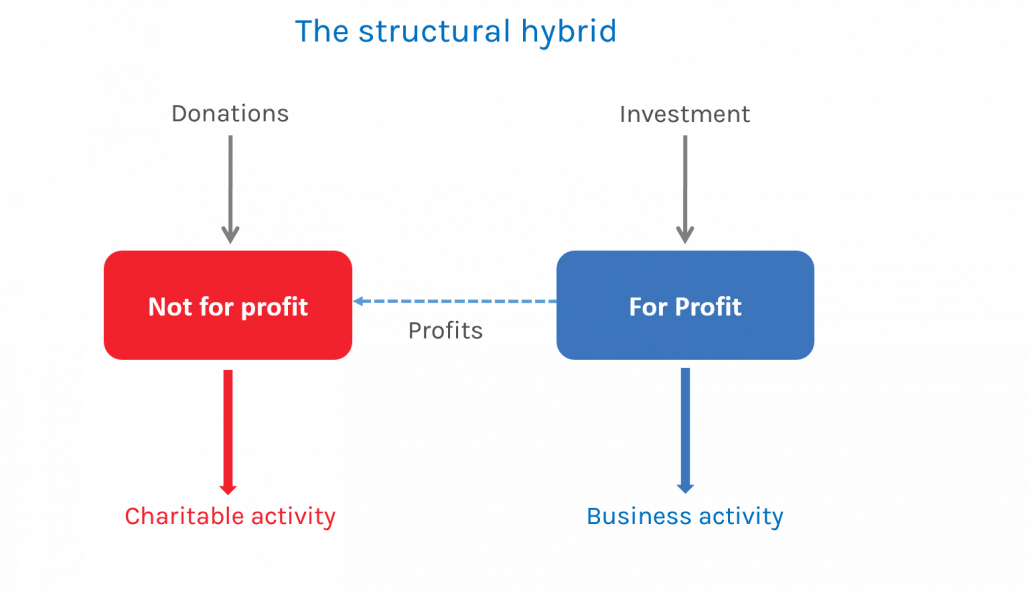
As a solution to this dilemma, many social enterprises are becoming “hybrid”: They divide their business activities into those that can generate income and profits (1) and those that have a high social impact but are unlikely to ever become self-sustaining (2). This type of legal organizational form is called a "structural hybrid" or "hybrid organizational structure."
Of course, managing two legal entities instead of one requires additional effort. But if you're looking to scale your social impact and need larger amounts of external growth capital, this extra effort can be worthwhile: The entire financing universe opens its doors.
“The West”: The business model
The right legal form also depends heavily on your business model. If your social entrepreneurial activities will never generate significant income, you can safely rule out hybrid structures or for-profit legal forms. However, if part of your business model has the potential to generate profitability and break even, then the basic requirements for an impact investment are met.
What impact investors pay attention to
The motivation of impact investors is essentially very simple: In addition to the social impact, they want to be able to see a good chance of generating a positive financial return on their investment. In other words, they will closely examine the surplus that the social entrepreneurial business model promises to generate.
Will the revenue consistently exceed the costs within a reasonable timeframe? Will the social entrepreneur be able to repay the capital provided along with a positive return? If the answer to these questions is "yes," investors will take notice.
Imagine if you had the freedom to choose among all available financing instruments. Which one would you choose? Basically, there are two basic forms and a hybrid intermediate variant: Debt, equity and mezzanine.
Advantages and disadvantages of the different forms of financing
All of these forms, of course, have their risks and side effects. Equity investors, for example, become true partners in the social enterprise and bear their share of the profits and losses. However, they also participate in the business decisions. Furthermore, they need an "exit" after a few years, meaning they want to resell their shares to recoup their capital along with a healthy return.
Lenders, on the other hand, are interested in a fixed repayment and usually require security or a guarantee for their borrowed capital. This is something a social enterprise can and will either provide—or not. Furthermore, lenders tend to be passive and generally have no voting rights. Their investment ends automatically once the loan, including interest, is repaid.
“Quasi-equity” as the best solution?
So what's the best solution? Similar to the dilemma surrounding legal forms, social entrepreneurs often find themselves at a dead end here: Neither equity nor debt capital really fits their business model. Time for a hybrid solution: mezzanine. Mezzanine (also called "quasi-equity") is highly flexible and combines the characteristics of debt and equity. Investors and social enterprises generally agree on exactly what these characteristics should be.
For example, investors could receive a share of the social enterprise's revenue instead of fixed interest payments and repayments. This solution gives the social enterprise more flexibility in terms of cash flow, which can be particularly useful in the early stages of company development. Otherwise, the model could have more typical characteristics of a debt capital provider. This special form is calledI “Revenue Sharing Agreement” or “revenue sharing model”.
But there are many other ways to create a tailored social financing solution. For those interested in delving deeper into this topic, we recommend the case studies from FASE.2.
Click here for part 2 of the guest article, which is dedicated to the topics of “development stage” and “social impact”.
1 See also interview with Felix Schäfer from Bürgerwerke eG at http://fa-se.de/blog/wir-sprechen-jetzt-social-finance/
2 All case studies of hybrid social entrepreneur financing under http://fa-se.de/fallstudien/
About the author
 Christina Moehrle has been working as a freelance author and specialist journalist since 2012 with the mission of supporting social entrepreneurs and impact investors and bringing both sides together through increased knowledge of social finance. Since 2014, she has also been responsible for communications at FASE, the financing agency for social entrepreneurship.

