We all know the phrase "data as raw material." However, many companies still don't recognize the value and potential of their data. The Munich-based startup Celonis raises the digital treasure and thus brings transparency to companies.
A lack of transparency is a real problem for companies: processes become routine, and we do things as we are used to without thinking about it. Practice makes us blind to the business. The problem isn't getting any less under digitalized conditions, as Celonis co-founder Bastian Nominacher in an interview with Munich Startup:
"Digitalization generates incredible productivity. At the same time, companies today are also faced with increased complexity, so it's enormously helpful to see exactly what's happening in the company and how."
His startup set out to solve the problem of a lack of transparency in companies' business processes. Celonis has developed an application based on a technology called "process mining" that aims to shed light on everyday processes. The work of the Celonis software can be imagined as that of a management consultant analyzing an organization's processes. The goal is to identify inefficient processes and thus optimize the company's operations. The difference, however, is that it is not people who analyze and visualize the processes, but software that continuously evaluates the data in real time.
The startup has struck a chord with its technology. The young company's credentials speak for themselves: In addition to medium-sized companies like the family-owned Schukat, companies such as Airbus, Bayer, Siemens, Nestlé, and Vodafone, as well as consulting firms Deloitte and KPMG, also work with Celonis. According to Celonis, 30% of all DAX-listed companies use their software. SAP even markets it in its own product portfolio as "SAP Process Mining by Celonis."
“The traces are everywhere.”
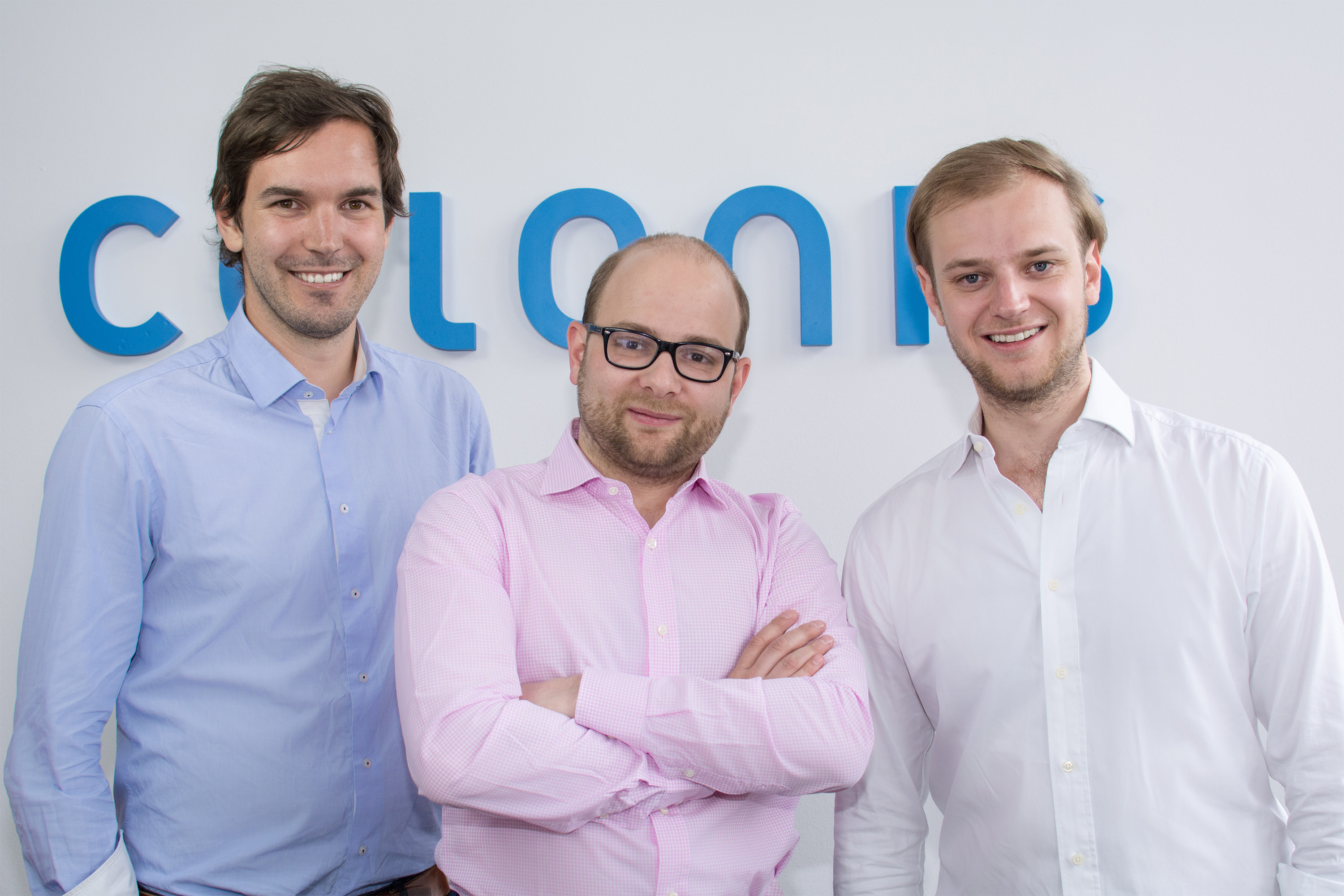
The origins of Celonis lie in the student consulting firm Academy Consult München eV. Founders Bastian Nominacher, Martin Klenk, and Alexander Rinke worked there together. All three were studying at the Technical University of Munich at the time. Martin Klenk is a computer scientist, Alexander Rinke a mathematician, and Bastian Nominacher holds a bachelor's degree in business informatics and a master's degree in Finance and Information Management (FIM). In other words, all three are experts in their field and familiar with the technology. For Nominacher, one of the success factors:
"In terms of our expertise, we could still operate Celonis with just three people today, but our resources have long since sufficed. Initially, I also helped with programming. It's very important for managers today to understand technological trends."
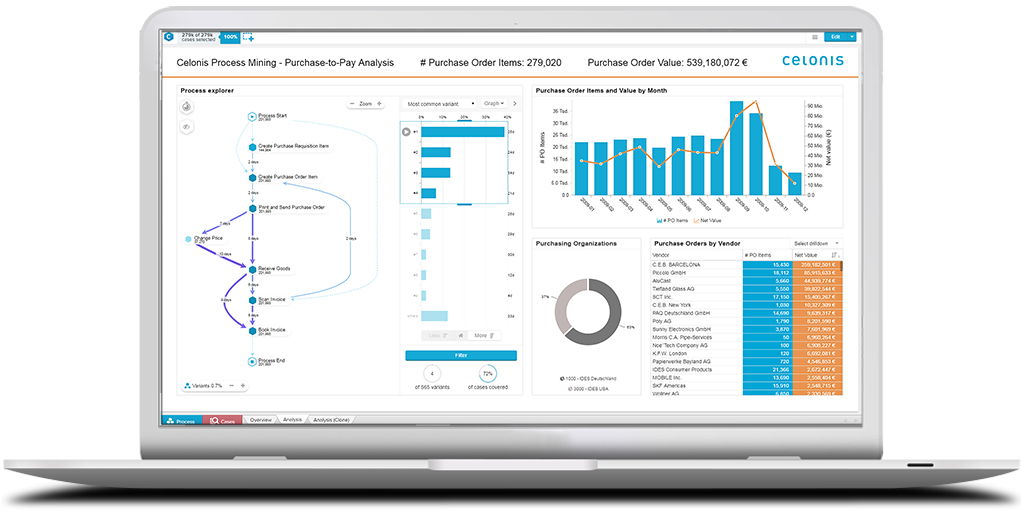
The technology behind Celonis is process mining. The three founders encountered the topic during their studies. This form of data analysis was still relatively unknown in this country at the time. What's special, according to Nominacher, is that it's a fundamental technology that can be used anywhere digital data is available:
"Almost every transaction today leaves digital traces in companies' IT systems – and we take advantage of them. Wherever traces can be found, we can evaluate them. And the traces are absolutely everywhere."
The possible applications of the Celonis software are accordingly diverse:
"Siemens uses Celonis to better organize its supply chain, RWE optimizes its lead times, and KPMG uses it for compliance audits. For example, we evaluate our own application process with Celonis."
His goal is to make more customers – even outside Germany – aware of his own product.Evangelize the market“ he calls it.
Offices in Munich, the Netherlands and New York
Process mining originated in the Netherlands; the computer science approach was researched at Eindhoven University of Technology. Demand there is high, and Celonis maintains its own branch. The company also operates an office in New York. Alexander Rinke manages North American activities from there. Celonis has long been an internationally operating company with headquarters in Munich.
Celonis secured funding for its international expansion mid-last year from investment firms Accel Partners and 83North. Facebook investors invested $27.5 million in the Munich-based company. For the previous five years, the company had been operating independently and could have continued operating in that way, says Nominacher:
"Purely financially, the investment wouldn't have been necessary; we're profitable and growing rapidly. As a startup, you have to differentiate: Are you raising capital because of the liquidity you need or for strategic reasons? For us, liquidity wasn't the issue, but rather the desire to bring the right strategic partners on board."
The company is not currently planning to raise any further capital. Far more important than financial investments is its partnership with SAP. The software giant is putting its full sales power at the company's disposal:
"Working with SAP is extremely strategic for us. It gives us access to thousands of additional sales representatives worldwide—a critical advantage in our market."
“There is nothing that would move us away from Munich”
The continued success is also making itself felt spatially: Space at the Munich headquarters is becoming scarce. In the last six months alone, Celonis hired more than 50 new employees. The move to a new office in Munich is imminent. Moving away from the Bavarian capital is out of the question for Nominacher:
"Munich is the perfect location for us. Many large companies are located here, and with over 100,000 students at the TU, LMU, and FH, we have an incredibly strong talent base. So, there's nothing that would keep us away: We attract good people, have a great network, and many customers."
When asked whether the competition in recruiting staff from Munich-based companies is not very fierce, Nominacher is confident:
"We operate in a different way than large corporations. Someone who wants to join a corporation has a different personality and a different set of goals than our employees. We offer very attractive jobs, few hierarchies, and extremely rapid advancement opportunities. And that's what makes us successful; we receive around 1,000 applications every quarter."
Advice from the algorithm
The company has high hopes for "Celonis Pi" ("Proactive Insights"), a further development of the process mining technology that the company launched at the end of last year. So far, the software has captured and identified running processes. With Celonis Pi, the company is integrating machine learning components:
"Pi is an engine we've been working on for a year and a half. Pi combines process mining with machine learning and artificial intelligence and automatically suggests certain patterns. Users have previously analyzed their processes with Celonis. Pi goes a step further and independently draws attention to problems and bottlenecks. Pi not only works exploratively, but also provides fully automated smart recommendations."
Another step in the mission to ensure data gets its due. Or, as stated at the beginning: data is a raw material. Celonis are thus something like the gold miners of the digital world.