
Solid success: With services related to electromobility and battery technology, the Munich-based startup LION Smart has advanced from a TUM spin-off to a successful player since 2008. The in-house holding company LION E-Mobility generated a surplus of almost 500,000 euros last year. How did this happen? A lesson in five acts.
I. It all starts with the market gap
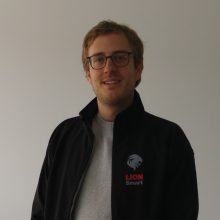
Tobias Mayer, co-founder of LION Smart and still a student at the time of its founding, looks back:
“Test benches were in high demand in 2008, as we had experienced firsthand in a previous project at the university. Accordingly, the margins were also very good. We thought: Something has to be done about it. Let’s build a laboratory with the know-how we have acquired so far!”
Together with fellow students at the Technical University of Munich, Daniel Quinger and Michael Geppert, Mayer decided to found the company. They brought on board another fellow student and two business economists to provide additional expertise. The young entrepreneurs raised €100,000 of their own capital to establish LION Smart GmbH. Three investors contributed a further €200,000.
II. Quickly into the profit zone
The team was able to land its first orders straight away and grow organically with profits from its operating business. It's the gap in the market that makes it. One success factor for Mayer in the early stages was the relatively high equity investment he made at the start-up:
"It's often a mistake for founders to invest only the minimum. As soon as a business is people- or hardware-driven, you need money. This may be different with software applications, when the founders program without their own salary. But with our test lab, we immediately said: It's pointless to start the company with the minimum requirements."
III. Growing with the market
The next milestone in the company’s history was set in motion from outside: The TÜV SÜD AG became aware of LION Smart's test laboratory. The large Munich-based company wanted to set up its own battery testing laboratory but couldn't find suitable staff. There was no specialized training available, and the market was new. TÜV SÜD wanted to acquire the young company and employ the founders. However, the founders weren't so easily persuaded, as they had only just begun their entrepreneurial careers. They agreed to establish a joint venture: 70% shares for the senior partner, 30% for the startup.
LION Smart sold the existing test benches to the newly created TÜV SÜD Battery Testing GmbH. At this point, the company's equity was no longer sufficient for further expansion:
“We have seen that the market is growing very strongly, We have to invest there.“
For the first time, the company needed outside funding. However, in the midst of the Lehman Brothers crisis, venture capital was hard to come by, and bank loans were out of the question:
"The banks didn't yet understand our business model at the time. Even the board members showed great interest. However, the banks found it difficult to evaluate the new market segment, so they held back at the time."
The business economists in the founding team recommended a IPOThey already had experience with this. The company owners transferred their shares in LION Smart GmbH to the newly founded LION E-Mobility AG. The sold shares were freely traded on the stock exchange and are now widely held. The shareholders cashed out the proceeds from the share sale and provided them in the form of loans to the two limited liability companies—LION Smart and TÜV SÜD Battery Testing.
IV. Far-reaching decisions
At the instigation of the business economists involved, Switzerland was chosen as the location for the holding company for cost reasons. After they had sold their own shares and completely withdrawn from the business, Tobias Mayer came to the following realization:
"In retrospect, I wouldn't have gone public so early. Initially, the Swiss holding company was very cheap. But every year the regulations became more stringent. We're actually almost identical to a German stock corporation. However, these developments were difficult to predict. Hindsight is always 20/20."
In general, the decision to establish a stock corporation should be carefully considered:
"You have to use the AG vehicle well to use it sensiblyOtherwise, it costs a lot of money: the audited financial statements, the accounting. Our audit also has to be done by a state-supervised Swiss company. That's more work, and an audit like that costs a lot of money."
In retrospect, however, Mayer also sees clear advantages in the decision to establish a public limited company compared to privately managed companies:
“We were able refinance without banks at good conditionsThrough option programs, we allow our employees to participate in the company's success and thus retain them in the long term."
V. On to new shores
With the spin-off of battery testing into the joint venture, LION Smart's original business model was eliminated. Since then, the team has increasingly focused on monetizing its accumulated expertise and reputation. Three business areas were created.
First: ConsultingCompanies, authorities, and ministries rely on specialized expertise in the field of e-mobility. LION Smart offers expert reports.
The second business area: For the Prototype construction Even large car manufacturers rely on specialized external service providers. Their own departments often lack the innovative power of young, small companies. LION Smart supports car manufacturers in development, prototyping, and the path to series production.
Mayer has particular hope in the third business area, the company’s own Battery Management System (BMS)This is a circuit board with dedicated software. It's a brain, so to speak, that tells the vehicle how to get the most out of the battery. Essentially, every manufacturer has its own BMS. What's special, however, is that LION Smart offers all the software free of charge as open source. This makes the system significantly more flexible. The company monetizes its BMS through a freemium model: The software is free. Customization, warranty, and support all cost money. The company also sells the fully assembled circuit boards:
“There are the greatest economies of scale achievable. You only have to develop the hardware once. Delivering more boards is no problem for us. Larger quantities also reduce costs."
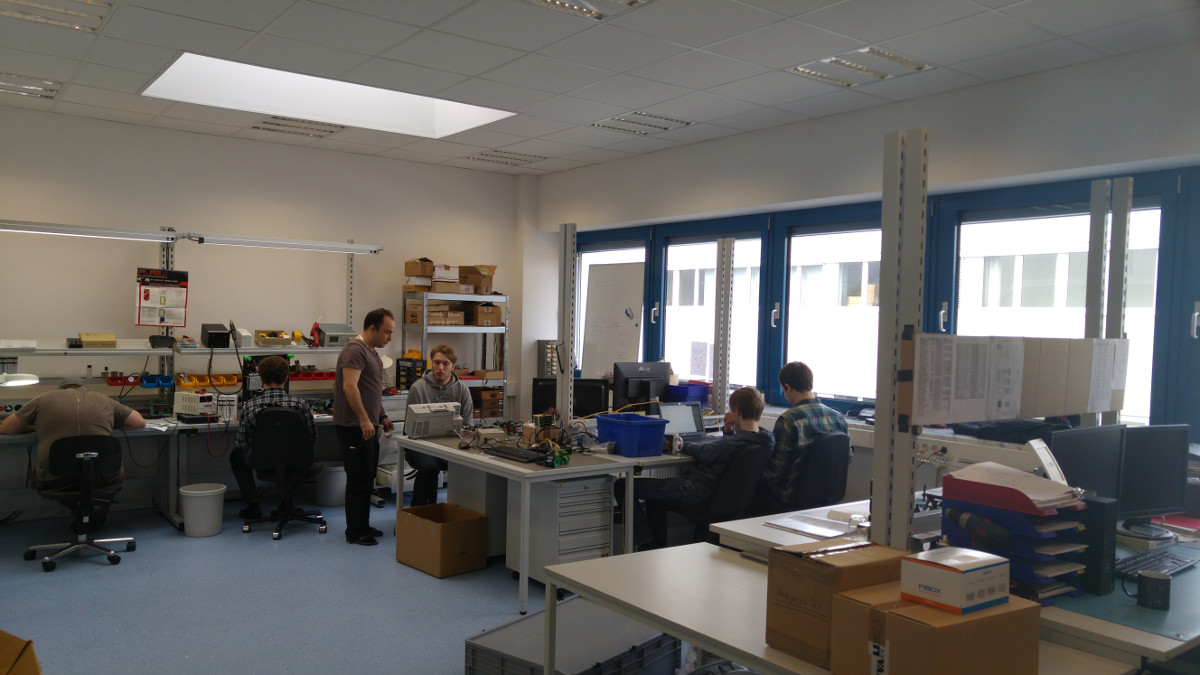
Speaking of scaling: At the end of December last year, LION Smart moved into new, larger premises. And new business areas are already on the horizon: The Renewable Energy Sources Act is expiring, and those with solar panels installed on their roofs will no longer necessarily be able to feed the generated electricity into the grid. Intermediate storage in large batteries could therefore be the future.
Apparently it will continue to Recipe for success cooked: business development on the horizon and courage to fill (market) gaps.

